
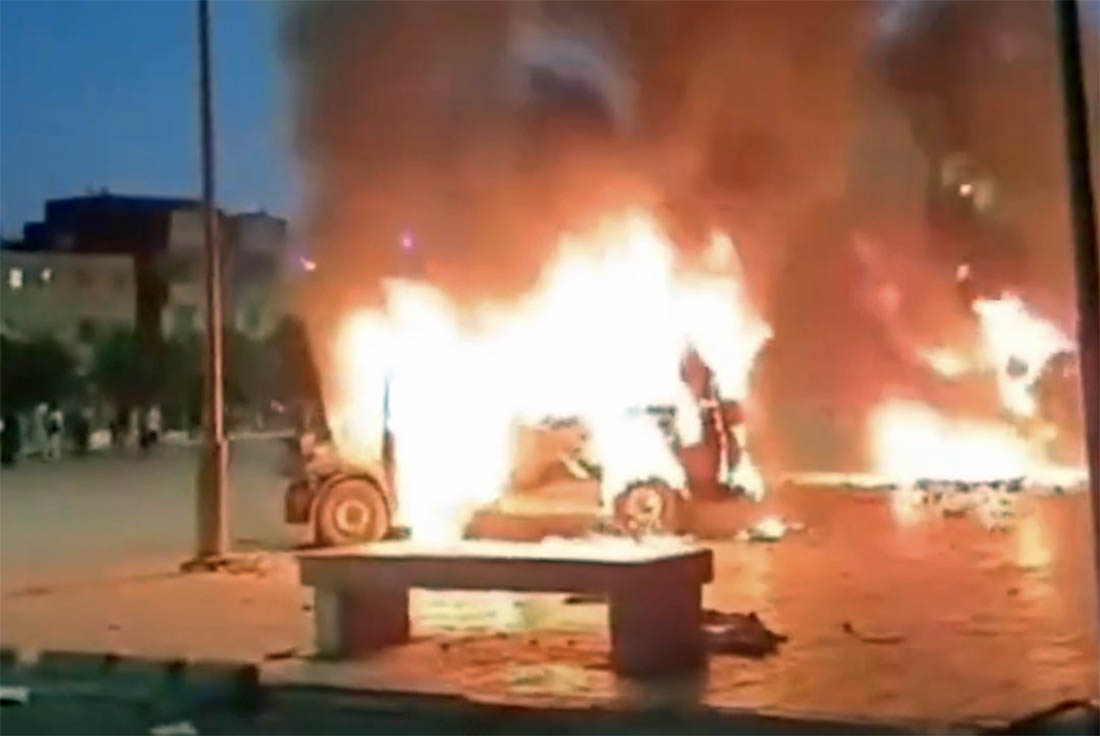
A burning car during the youth-led protests in Inzegane, near Agadir
Between rage and reason: vandalism is not the answer in Morocco's social protests
For protest movements, maintaining non-violent discipline is a strategic imperative. The youth-led movements must actively work to isolate those who resort to vandalism, clearly communicating that such acts harm their cause.
Wednesday 01/10/2025
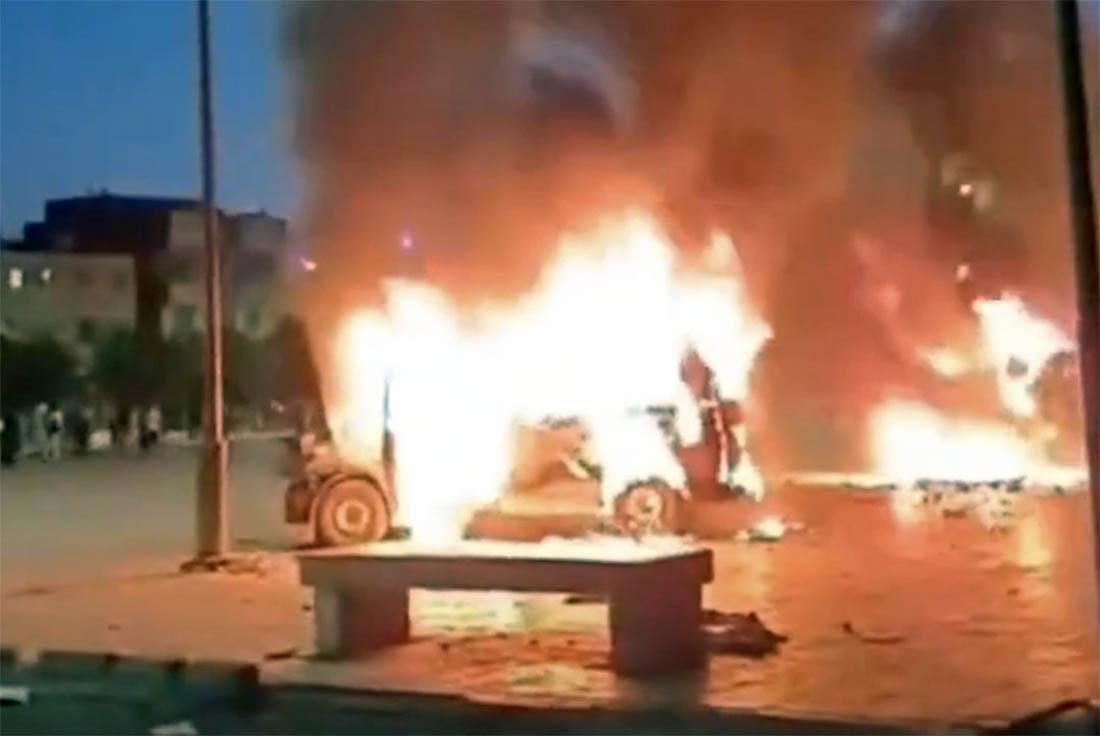
A burning car during the youth-led protests in Inzegane, near Agadir
In cities across Morocco, from the bustling economic capital of Casablanca to the small towns of the south, a scene of discontent led by the youth has played out. Crowds of young people, students, and concerned citizens gather, their voices united in a call for fundamental social rights: the right to quality education, better healthcare and the fight against corruption.
These are not demands for luxuries, but for the very pillars of a dignified life. Yet, these legitimate protests are punctuated by the sound of shattering glass, the graffiti on public walls, the ransacking of shops and the smoke of burning police cars - acts widely condemned as vandalism.
Videos circulating on social media showed shocking scenes of setting shops on fire, vandalizing supermarkets, setting bins on fire and hurling stones at police vans, prompting violent clashes with security forces.
To understand this phenomenon is to look beyond the simple label of "thuggery" and delve into the complex anatomy of frustration and above all the failure of dialogue between the government and the youth.
Legitimate grievances
The protests were organised online by a loosely formed, anonymous youth group calling itself "GenZ 212," using platforms including TikTok, Instagram and the gaming application Discord.
The roots of these protests lie in deep-seated and justified grievances. Morocco has made significant strides, but many of its citizens, particularly in rural and peri-urban areas, feel left behind.
Classrooms are often overcrowded in public schools, resources are scarce, and the curriculum is frequently criticized for being outdated and not aligned with job market needs. Private schools are mushrooming in major cities amid a growing demand from the upper middle class who long lost faith in public education.
Public hospitals suffer from chronic underfunding, a lack of medical staff, and shortages of essential medicines and equipment. For many, a medical emergency can mean financial ruin, forcing them to seek prohibitively expensive private care whose sector is expanding at an unimaginable pace.
Prime Minister Aziz Akhannouch’s government is perceived as a distant, unresponsive and non-communicative, turning frustration into rage that was sparked by earlier protests in Agadir over poor hospital conditions, which quickly spread to other cities.
In early 2024, a viral video emerged from the Souss-Massa Regional Hospital Center (CHR) in Agadir. The video showed a man, Mohamed Daki, who had died, left on a gurney in a hospital corridor in very poor and undignified conditions. His body was partially uncovered, with a used medical drip still attached to his arm, and he was surrounded by garbage.
The video caused widespread shock, anger, and grief across Morocco, sparking a national debate about the state of the country's public healthcare system.
The health ministry quickly suspended several staff members believed to be responsible, including the head of the emergency department and other medical and administrative personnel, while a formal administrative investigation was launched to determine the exact circumstances of the medical care provided and the handling of the body after death.
The incident prompted the Ministry to announce plans for a broader audit and improvement plan for emergency services in public hospitals across the country.
In late May 2024, a major scandal erupted at the Al Hassan I Hospital in the city of Agadir, Morocco, following the deaths of several patients in a short period. The situation caused public outrage, leading to a direct intervention from the Ministry of Health.
Over a period of a few days, at least seven patients in the nephrology and internal medicine departments died. Their families and local media attributed the deaths to severe negligence.
The then-Health Minister Khalid Ait Taleb announced the dismissal of the hospital's director and the head of the maintenance department for the failures in management and infrastructure upkeep. He confirmed that a formal administrative investigation had been launched to determine the exact causes of the incident and to identify all parties responsible.
In late June 2024, another tragic incident occurred at the Mohammed VI University Hospital Center in Agadir. Reports indicate that seven newborn babies in the neonatal intensive care unit died within a short period.
The initial and widely reported cause was a major disruption in the oxygen supply to the unit. This was not due to a lack of oxygen bottles, but rather a technical failure or a problem with the distribution system that delivers the oxygen to the infants' incubators.
Health Minister Amine Tahraoui addressed the incident directly and publicly, acknowledging the deaths and launching an official investigation to determine the exact cause of the technical failure.
The initial findings that pointed to a catastrophic failure of the oxygen system, stating that the incident was linked to "technical manipulations" of the gas distribution system.
Consequently, he announced the immediate suspension of several officials at the hospital, including the hospital director.
Last month, Tahraoui made a visit to Hassan II hospital after another scandal and sacked its director and the regional director of healthcare due to the persistent absence of the hospital’s staff and the lack of medical supply and equipment breakdown.
The dismissal of the medical staff over the last few years clearly shows the mismanagement in these hospitals besides the government’s negligence of these repeated problems that infuriated the public.
Vandalism is not the language of claiming demands
These repeated blunders in the same hospital would have forced the Prime Minister to either sack the health minister or call for his resignation in the West; something that Moroccans are vehemently calling for but will very likely not materialize.
The youth-led protesters were at first calling for peaceful protests in order to have their demands heard, but degenerated and became violent, brutal and disruptive.
Blocking roads with burning tires, cars and police vans, damaging public property is the wrong way to exert more pressure on the state.
Journalist and influencer Samid Ghailan denounced on Instagram the violence and vandalism and the way protesters waged a war on the freedom of expression in the name of change despite supporting their demands.
He also lashed out at the leaders of political parties and trade unions for failing to raise awareness among the youth about the dangers of destruction and harm caused to fellow citizens.
Vandalism has now provided the authorities with a clear and legitimate pretext for a heavy-handed response. The youth-led discourse will consequently change from addressing social grievances to enforcing public order and prosecuting criminal acts of violent protesters whose moral high ground will be easily lost. As a result, the "GenZ 212" movement's agenda has now been hijacked by its most destructive elements.
The most effective antidote to violent protests is responsive governance. Establishing genuine, transparent channels of dialogue with civil society and protest movements and holding officials and ministers accountable for the grave errors is crucial.
Citizens want to see the government’s serious engagement that can lead to concrete results — better hospitals and schools — rather than a cosmetic change that will not change the core problems.
For protest movements, maintaining non-violent discipline is a strategic imperative. The youth-led movements must actively work to isolate those who resort to vandalism, clearly communicating that such acts harm their cause.
A broader public conversation is needed to acknowledge the deep-seated frustration while unequivocally rejecting destruction. Political leaders, media, and intellectuals have a role in framing the issue not as a law-and-order problem alone, but as a symptom of a deeper social malaise that requires collective addressing.
The shattered glass and charred tires and cars in the streets of Morocco are a symptom of a broken dialogue. The challenge for the Moroccan government is to heal this rupture, to ensure that the passionate cry for education and healthcare is met not with the sound of breaking windows, but with the constructive sound of building a more just and equitable society for all.