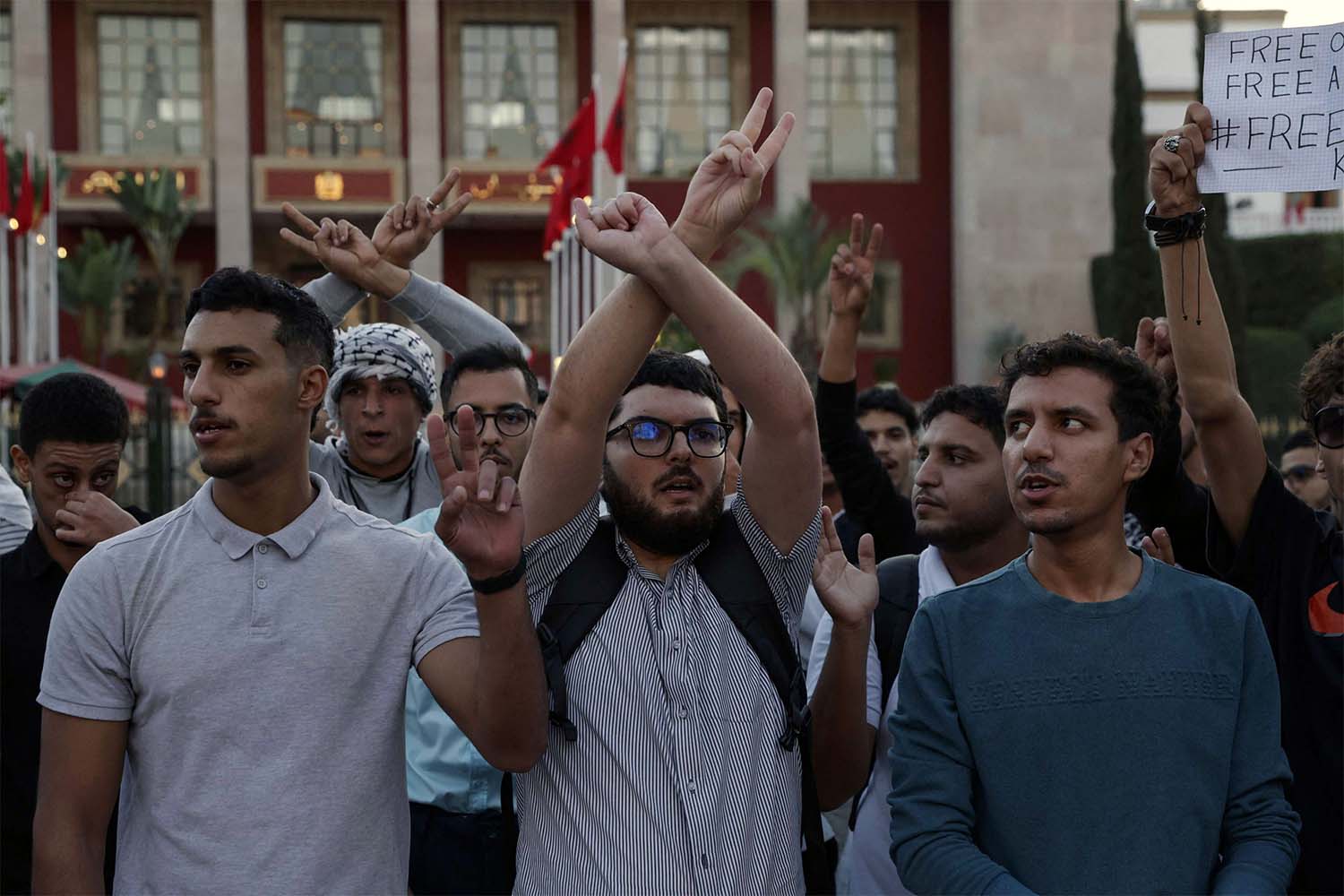
Demonstrators gesture during a youth-led protest demanding reforms to public healthcare and education in front the Parliament in Rabat
Business as usual… Despite the spiteful
Morocco, having learned from the experience of 2011 which led to major political reforms including a referendum on a new constitution, will emerge from the experience of recent events as a stronger and more cohesive country.
Tuesday 07/10/2025

Demonstrators gesture during a youth-led protest demanding reforms to public healthcare and education in front the Parliament in Rabat
There is no cause for concern in Morocco, despite all the attempts made by those who resent the Kingdom in light of the successes it has achieved at all levels in recent years. Every Moroccan citizen feels responsible for their country. The bounds of Moroccan patriotism are limitless, exemplified by that relationship between the Throne and the people, which was clearly demonstrated through the attachment to the Moroccan identity of the Sahara.
Little by little, the country is returning to normal after a week of unrest that revealed how misplaced the bets of those who resent Morocco truly are. There is a normal situation in Morocco, despite the spite of the resentful. Now that things have calmed down, the Moroccan people are awaiting King Mohammed VI's speech at the opening of the House of Representatives session next Friday. The Moroccan monarch will, without a doubt, set the record straight; he has always shown the extent of his follow-up to every detail in the Kingdom and his keenness for the citizen's welfare and providing a decent standard of living.
What enabled Morocco to return to normal is that deep feeling of reassurance and care for the country, after the ordinary citizen discovered that there is no horizon for a popular movement with legitimate demands. The citizen realized that there are parties that want to harm Morocco for the purpose of sabotage, not to achieve demands, neither in the field of health nor education. The credit for confronting a group that wanted to spread chaos and divert the movement from its goals does not go only to the security services, which sought to put an end to the rioting, but also to the awareness of the Moroccan citizen who appreciates what has been achieved in their country and cares about preserving achievements away from political posturing and empty slogans that do not put bread on the table.
The ordinary citizen knows that King Mohammed VI, in his last speech on the occasion of the Throne Day last July, had all the courage to admit the existence of negatives that need to be addressed. He did so without complexes, especially since the relationship between the Moroccan Throne and the people is historically characterized by frankness, openness, and mutual trust. These negatives, which the government of Aziz Akhannouch did not address seriously, prompted the youth of "Generation Z212" to take to the streets in Moroccan cities and several areas to protest a significant shortcoming in the fields of education and health. But the Moroccan youth soon began to ask questions when they found that groups resorted to violence and sabotage and assaulted police officers…
Two months and a few days ago, the knowledge of the existence of these negatives led the Moroccan monarch to state unequivocally that "there are still some areas, particularly in the rural world, that suffer from manifestations of poverty and fragility, due to a lack of infrastructure and basic facilities, which does not align with our conception of Morocco today, nor with our efforts to promote social development and achieve justice. For there is no place, today or tomorrow, for a Morocco of two speeds."
The Moroccan monarch was clearly pointing to the need to avoid any gap between one sector and another, and between one region and another. Meaning that development must include all social classes and all regions if Morocco is to be at the required level as a country reconciled with itself and capable of being an extension of Europe in the Dark Continent. More importantly, Morocco is seeking an integrated development process that includes the health and educational fields, with full awareness of the meaning of the existing shortcomings in government hospitals and public schools.
Mohammed VI noted the existence of gaps at a time when the Kingdom is witnessing real growth at all levels, confirmed by figures. From this standpoint, and due to the existence of negatives, it was not surprising that Moroccan youth took to the streets to achieve legitimate demands in a country facing great challenges after it has become a real bridge between Europe and Africa, in light of the breakthroughs achieved since Morocco regained its position in the African Union at the beginning of 2017. More than that, Morocco now has an African presence that is beyond doubt. This presence has positively reflected on the national cause, the issue of the Moroccan Sahara, which has become a matter of international recognition beyond debate. It is clear that this international recognition of the Moroccan identity of the Sahara has caused regional parties, foremost among them the Algerian regime, to lose their composure…
Significant sabotage occurred in Morocco, affecting official institutions, public facilities, and private property belonging to companies and citizens. Major losses occurred in several cities, but popular awareness and the restraint exercised by the various security agencies ultimately prevailed over the orchestrated mob and the attempt to spread chaos. The security agencies exercised restraint on instructions from the higher authorities despite all the provocations they were subjected to in several areas.
Just as Morocco learned from the experience of 2011, which led to major political reforms including a referendum on a new constitution, it will emerge from the experience of recent events as a stronger country. However, the authorities will bear the responsibility of identifying the parties behind the rioting, sabotage, and attempts to destabilize the Kingdom. Naturally, it will be necessary to hold responsible government officials accountable for the shortcomings in the fields of education and health.
In the end, Morocco has become the only oasis of stability in North Africa, regardless of the existence of negatives that need real treatment to block the way for political posturing, posturers, and instigators who will need to be named at a certain stage. It is not limited to the Algerian regime, which has been waging a war of attrition against Morocco since 1975, but also includes European parties that consider themselves harmed by Morocco's new role in the region and in the African depth…
Nothing succeeds like success. Yes, there are negatives in Morocco. But there is success on various fronts that the resentful will not be able to undermine for an extremely simple reason. This reason is the Moroccan citizen's belief in their country
Khairallah Khairallah is a Lebanese writer
The views expressed are solely those of the author and may or may not reflect those of Middle East Online.