


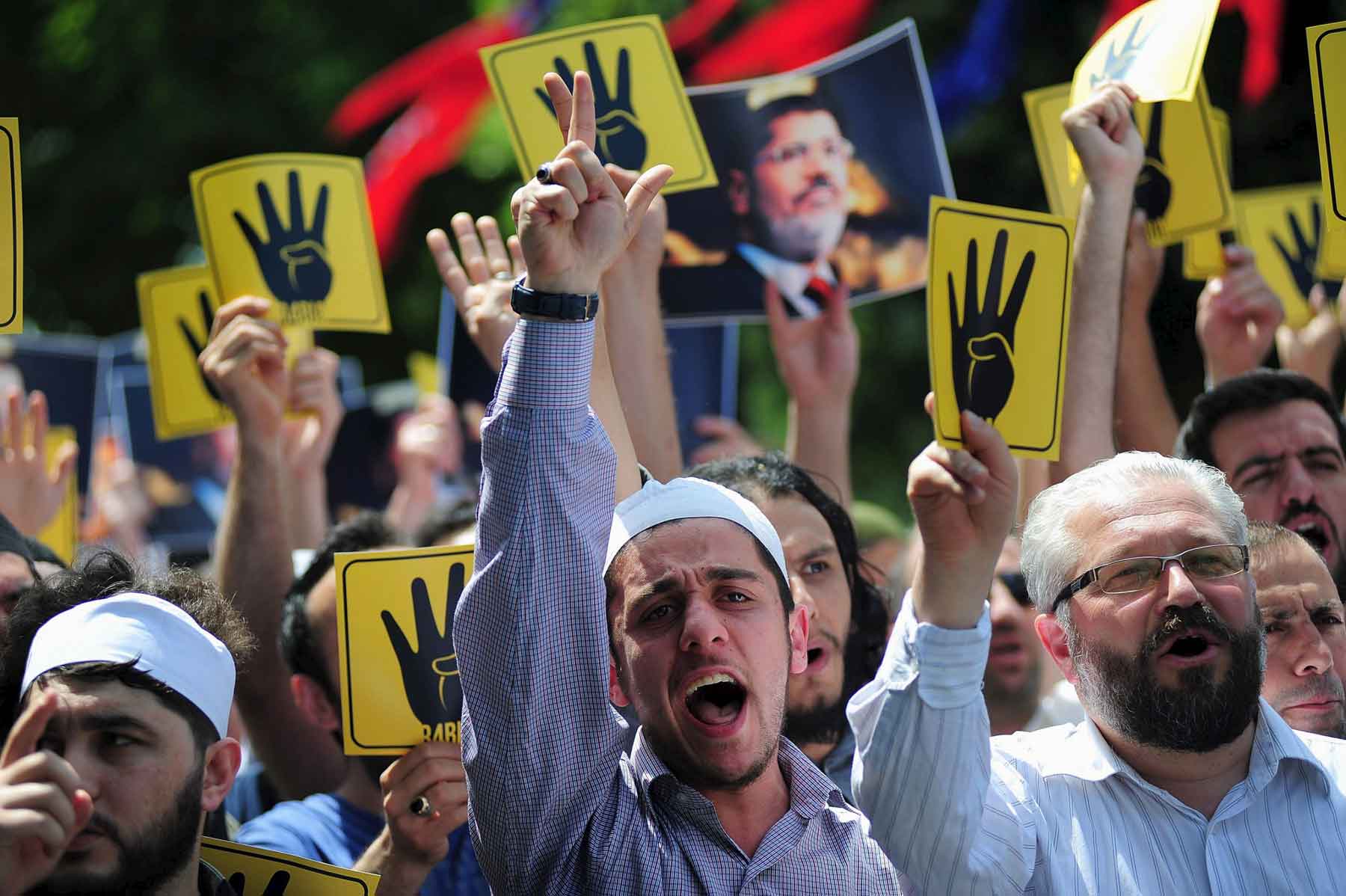
A 2015 file picture shows pro-Islamist demonstrators holding signs that show the Rabaa hand gesture, which symbolises support for the Muslim Brotherhood, during a rally in in Istanbul, Turkey.
Florida joins Texas in high-stakes drive to blacklist Muslim Brotherhood
The move immediately triggered legal backlash and widened a national political fissure over Islam, security and civil liberties.
Tuesday 09/12/2025
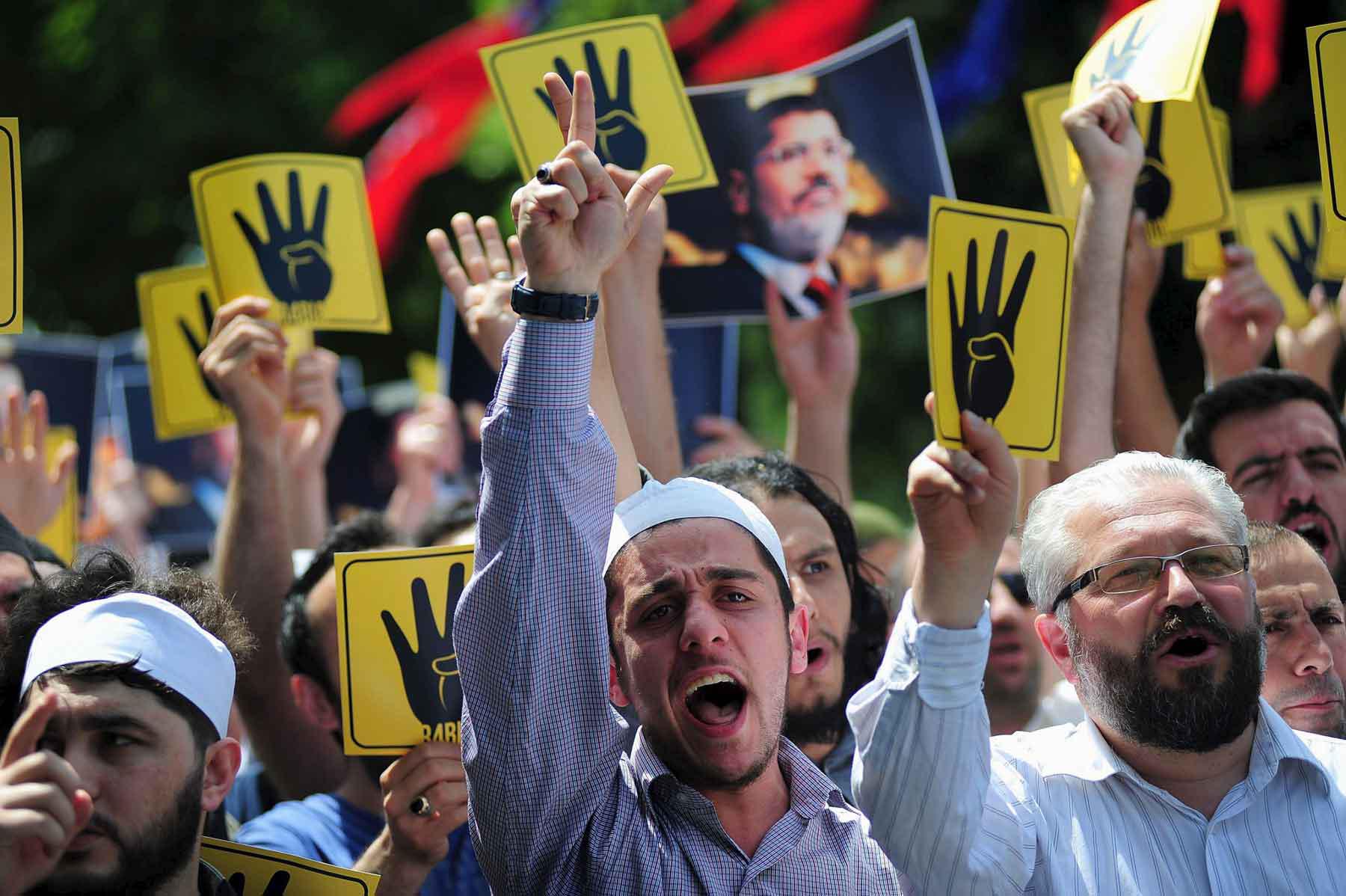
A 2015 file picture shows pro-Islamist demonstrators holding signs that show the Rabaa hand gesture, which symbolises support for the Muslim Brotherhood, during a rally in in Istanbul, Turkey.
WASHINGTON
Florida intensified a widening Republican campaign against the Muslim Brotherhood after Governor Ron DeSantis designated the transnational Islamist movement, along with the Council on American-Islamic Relations (CAIR), as “foreign terrorist organisations,” a move that immediately triggered legal backlash and widened a national political fissure over Islam, security and civil liberties.
DeSantis declared the designation “EFFECTIVE IMMEDIATELY” in an executive order issued late on Monday, directing all state agencies to “undertake all lawful measures to prevent unlawful activities by these organisations, including denying privileges or resources to anyone providing material support.”
CAIR, the largest Muslim civil rights group in the United States, vowed to sue, accusing the governor of signing a “defamatory and unconstitutional order baselessly smearing” the organisation and prioritising “serving the Israeli government over serving the people of Florida.”
The group noted that DeSantis held his “first official cabinet meeting in Israel” and has maintained close ties with the country’s leadership.
A widening state-level push
Florida’s move closely mirrors an executive order issued in Texas in November by Governor Greg Abbott, who likewise labelled both the Muslim Brotherhood and CAIR as foreign terrorist organisations and ordered his attorney-general to “sue to shut them down.” CAIR has already filed suit in Texas, arguing that the state has no authority to create its own terrorism list, particularly when neither group appears on the US federal terrorism registry.
The parallel orders signal an increasingly coordinated Republican effort. Analysts say the synchronised push from Texas and Florida, two of the most politically influential Republican-led states, suggests the issue is shifting from isolated conservative activism to a broader party position as the country heads towards a contentious election year.
DeSantis indicated that members of the Florida Legislature were preparing to embed the designation into state law, writing on X that lawmakers were “crafting legislation to stop the creep of sharia law.”
Claims of ideological threat
In his order, DeSantis claimed, without providing evidence, that the Muslim Brotherhood seeks to establish “a world-wide Islamic caliphate” and maintains direct links to Hamas, including to the October 7 attacks on Israel. He also asserted that CAIR was “founded by persons connected to the Muslim Brotherhood” and referenced its listing as an “unindicted co-conspirator” in a major terrorism-financing case more than a decade ago.
CAIR has consistently denied any ties to Hamas or the Muslim Brotherhood and says it “unequivocally condemns all acts of terrorism, including by Hamas”.
The Muslim Brotherhood itself describes the accusations as ideological distortions. The movement, founded in Egypt in 1928, has long been viewed by US conservatives as a flexible network capable of operating through civil-society, charity and cultural fronts while taking advantage of Western freedoms to expand influence.
Critics argue the group deploys “dual discourse”: adopting an open, democratic tone when dealing with Western governments but advancing a stricter ideological agenda in regions where it has political footholds.
Why Republicans are escalating now
Observers note that this surge in designations does not come out of nowhere. The tumultuous aftermath of the Arab Spring, and particularly the Muslim Brotherhood’s brief and divisive rule in Egypt after 2011, fuelled deep scepticism within US policy circles about the group’s long-term intentions. Washington policymakers increasingly viewed the Brotherhood as an ideological movement capable of embedding itself in civil society while remaining opaque, structured and transnational.
Security analysts have since argued that while the Brotherhood is not itself a militant group in the United States, its ideological ecosystem can provide political and social space for more extreme organisations to develop, a claim strongly rejected by the Brotherhood and its supporters.
Regional allies have also shaped the trend. Countries including Egypt, Saudi Arabia and the UAE, all of which classify the Muslim Brotherhood as a terrorist organisation, have provided Washington with extensive intelligence dossiers on the group’s networks, financing structures and links abroad, influencing how parts of the US security establishment perceive the Brotherhood’s activities.
A federal vacuum that empowered the states
The Republican momentum at state level follows a directive signed earlier this year by President Donald Trump, instructing federal agencies to explore whether any branches of the Muslim Brotherhood abroad should be designated as terrorist groups. Though the guidance has not resulted in a federal designation, it opened space for individual states to move aggressively on their own.
Legal experts say the Florida and Texas orders may test the limits of state authority in defining foreign terrorism, a domain traditionally reserved for the federal government. CAIR’s lawsuits are likely to produce complex constitutional battles over speech, civil rights and the boundaries of state power.
A turning point for the Brotherhood in the US
Regardless of how the courts rule, analysts say the political climate appears to have shifted decisively. Within large parts of the conservative movement, and parts of the national security establishment, the Muslim Brotherhood is increasingly viewed as a long-term ideological threat rather than merely a foreign political movement.
As Florida and Texas expand scrutiny, sources expect a wave of administrative measures, including tighter monitoring of funding, restrictions on community activities and deeper investigations into organisations and individuals believed, fairly or not, to have intellectual or organisational links to the Brotherhood.
What was once an abstract debate about political Islam has hardened into a confrontation that may redefine the group’s presence in the United States for years to come.