



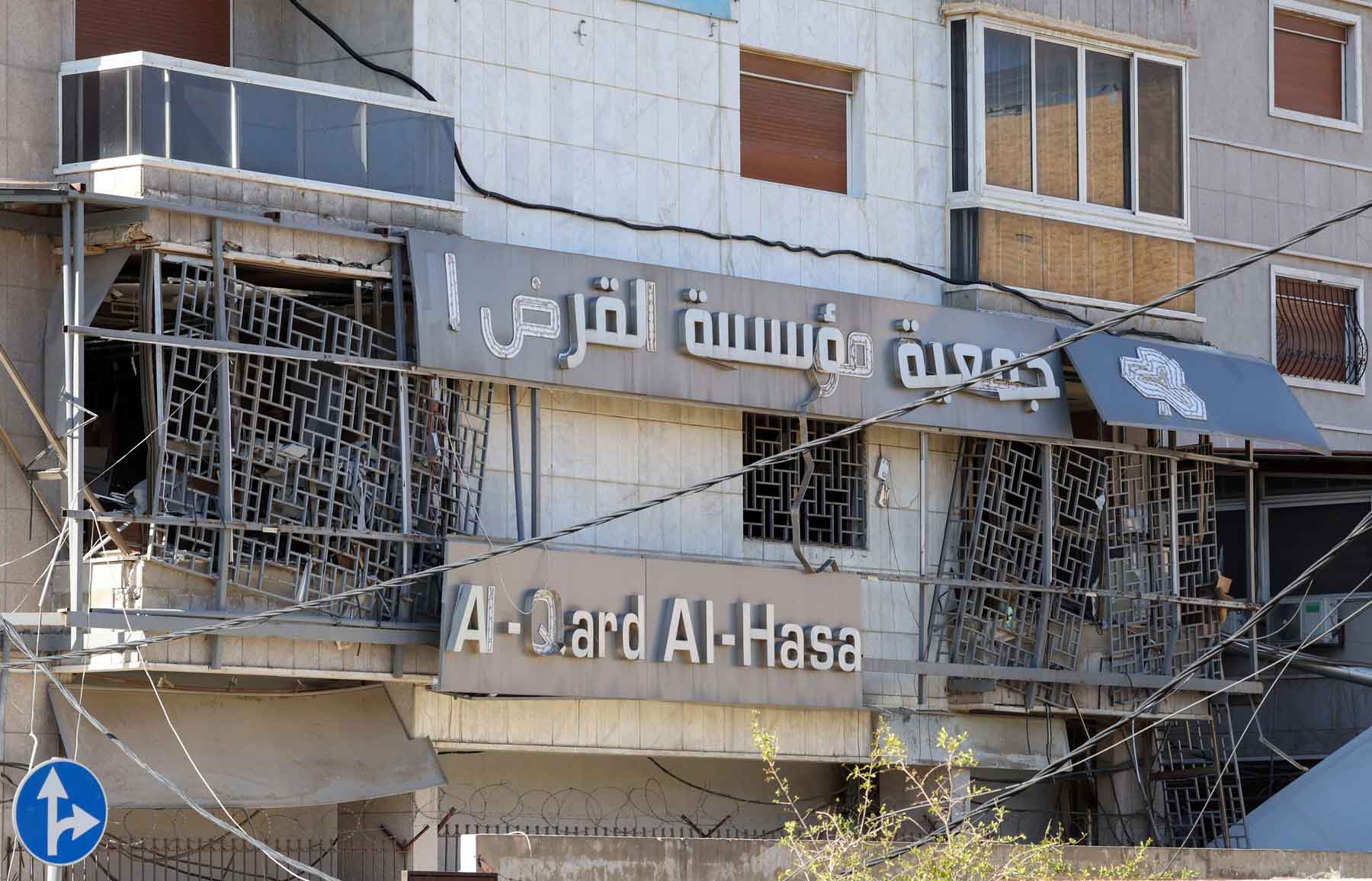
A view shows a damaged building which is a branch of Al-Qard al-Hassan, a financial institution linked to Lebanon’s Hezbollah, in the aftermath of Israeli airstrikes in Beirut suburbs, October 21, 2024.
Hezbollah seeks sanctions workaround with alternative to Al-Qard Al-Hassan
Al-Qard Al-Hassan has around 300,000 clients and financial activity estimated at $3 billion and tonnes of gold.
Monday 15/12/2025
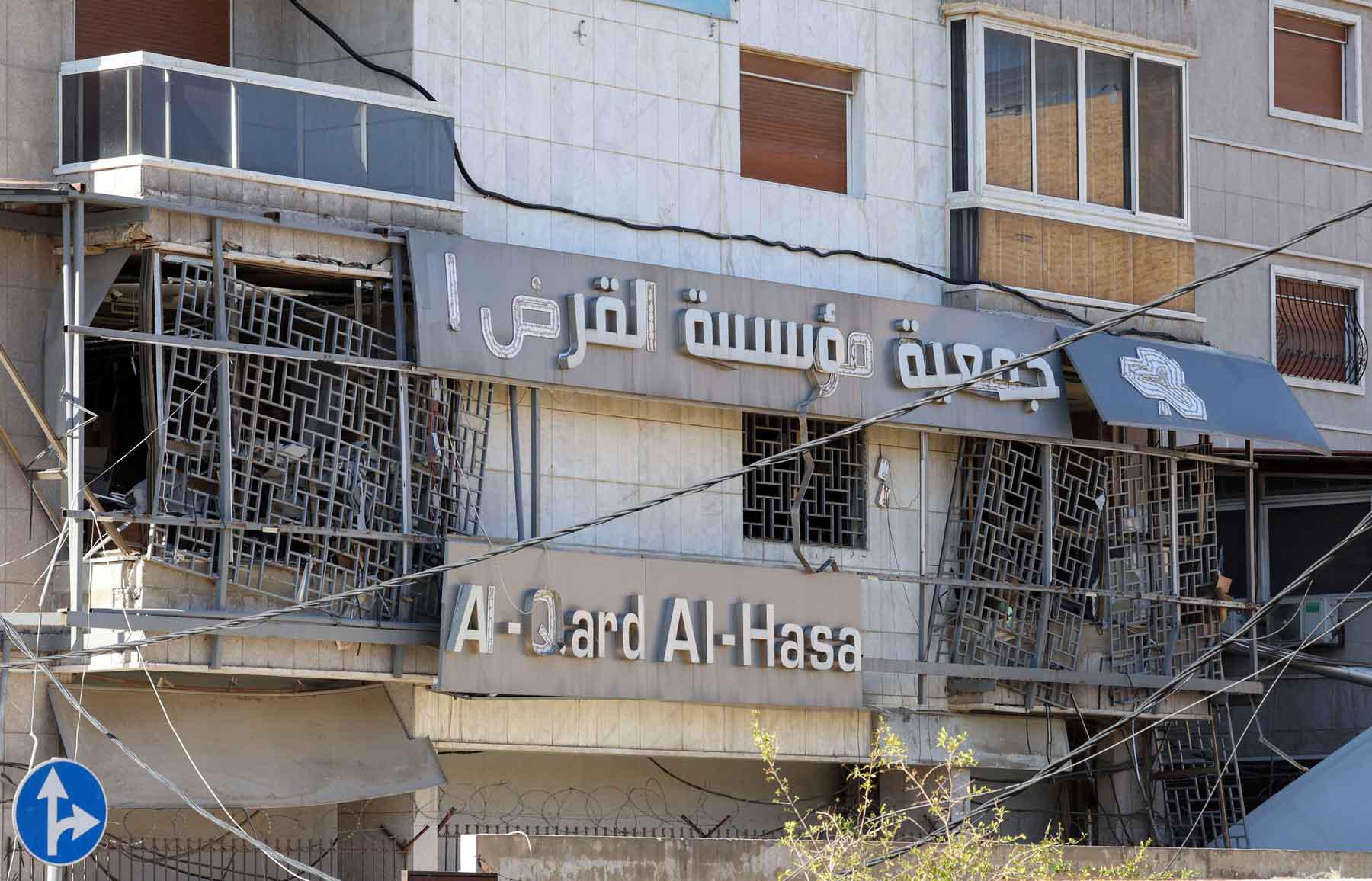
A view shows a damaged building which is a branch of Al-Qard al-Hassan, a financial institution linked to Lebanon’s Hezbollah, in the aftermath of Israeli airstrikes in Beirut suburbs, October 21, 2024.
BEIRUT -
Al-Qard Al-Hassan, an institution widely regarded as Hezbollah’s financial arm, has begun taking steps to deal with the current situation following US sanctions by establishing a licensed alternative commercial institution to lend to its supporters. Expectations are growing that additional entities may be created to share financial activities.
Hezbollah is aware that maintaining its financial arm is a key factor in ensuring the continuation of its influence over its popular base, which has been feeling frustrated by the heavy losses it has suffered as a result of wars and economic crises.
The group’s move to create an alternative to Al-Qard Al-Hassan comes as part of a search for a legal outlet that would not embarrass the Lebanese state in the face of foreign pressure, while at the same time preserving the financial institution, which has around 300,000 clients, financial activity estimated at $3 billion and tonnes of gold.
Hezbollah had previously rejected US demands that the Lebanese authorities shut down the institution. In November last year, its Secretary-General Naim Qassem accused the United States of attempting to “dry up financial resources in order to eliminate the party’s existence and prevent it from providing social services.”
Qassem advised “the government, the governor of the Banque du Liban and the relevant authorities to stop measures that tighten the noose around the party and all Lebanese.”
He stressed that “Al-Qard Al-Hassan is a social institution for all people and a social lifeline in these difficult circumstances… no one has the authority to prevent charity, assistance and solidarity.”
Local sources said the alternative to Al-Qard Al-Hassan is an institution called “Joud?” which operates by buying and selling gold on instalments. Anyone seeking a loan must pledge a quantity of gold, alongside other measures aimed at preventing any legal loopholes in its status.
These developments have sparked a wide outcry on social media, along with calls to monitor the new institution to prevent fresh crises in the country arising from Hezbollah’s activities.
Activists have warned of new sanctions targeting Lebanon as a result of Hezbollah’s alleged financial circumvention.
Well-informed sources said a special committee comprising officials from the institution alongside legal and financial experts was recently formed to study the new legal situation with the Ministry of Interior, which is responsible for the licence granted to the institution when it was established.
The sources said that “the campaign targeting Al-Qard Al-Hassan prompted members of this committee to visit the Banque du Liban and the Ministry of Interior, as the two bodies concerned with the institution, and they were briefed on the nature of its work.” They added that “discussions took place with the relevant authorities to dispel certain observations.”
Many Lebanese refer to Al-Qard Al-Hassan as “Hezbollah’s black bank,” viewing it as the party’s back channel for laundering money derived from the drug trade in Lebanon extending into Latin America. Hezbollah has sought to cloak this arm in a promotional campaign portraying it as an association that provides loans to the Lebanese people.
Al-Qard Al-Hassan, which was founded in 1982, operates outside the authority of Lebanon’s central bank, which does not know the volume of funds circulated through the institution.
The institution says it aims to “help people by granting them loans for fixed terms”, in order to support them in “resolving some of their social problems”, according to its website.
The association also says it “aims to strengthen the spirit of cooperation, mutual support and solidarity among members of society.”
Among its policies are “granting loans without discrimination or distinction on the basis of religion, sect, region or otherwise; granting loans to meet all needs, whether social or productive; and spreading branches across all Lebanese territory to save people’s time and reduce the burden of travelling from distant areas.”
Lebanese media report that the association now has around 31 branches in Lebanon, distributed across three main areas: Beirut, the south and the Bekaa.
The association has long sparked widespread controversy inside and outside Lebanon. The United States has imposed several sanctions on it for years, while Saudi Arabia classifies it as a “terrorist entity.”
At the beginning of December, non-bank financial institutions began applying a circular issued by the Banque du Liban around a month earlier requiring them to “collect information and data related to the clients of these institutions and their operations when carrying out any cash transaction equal to or exceeding $1,000.”