



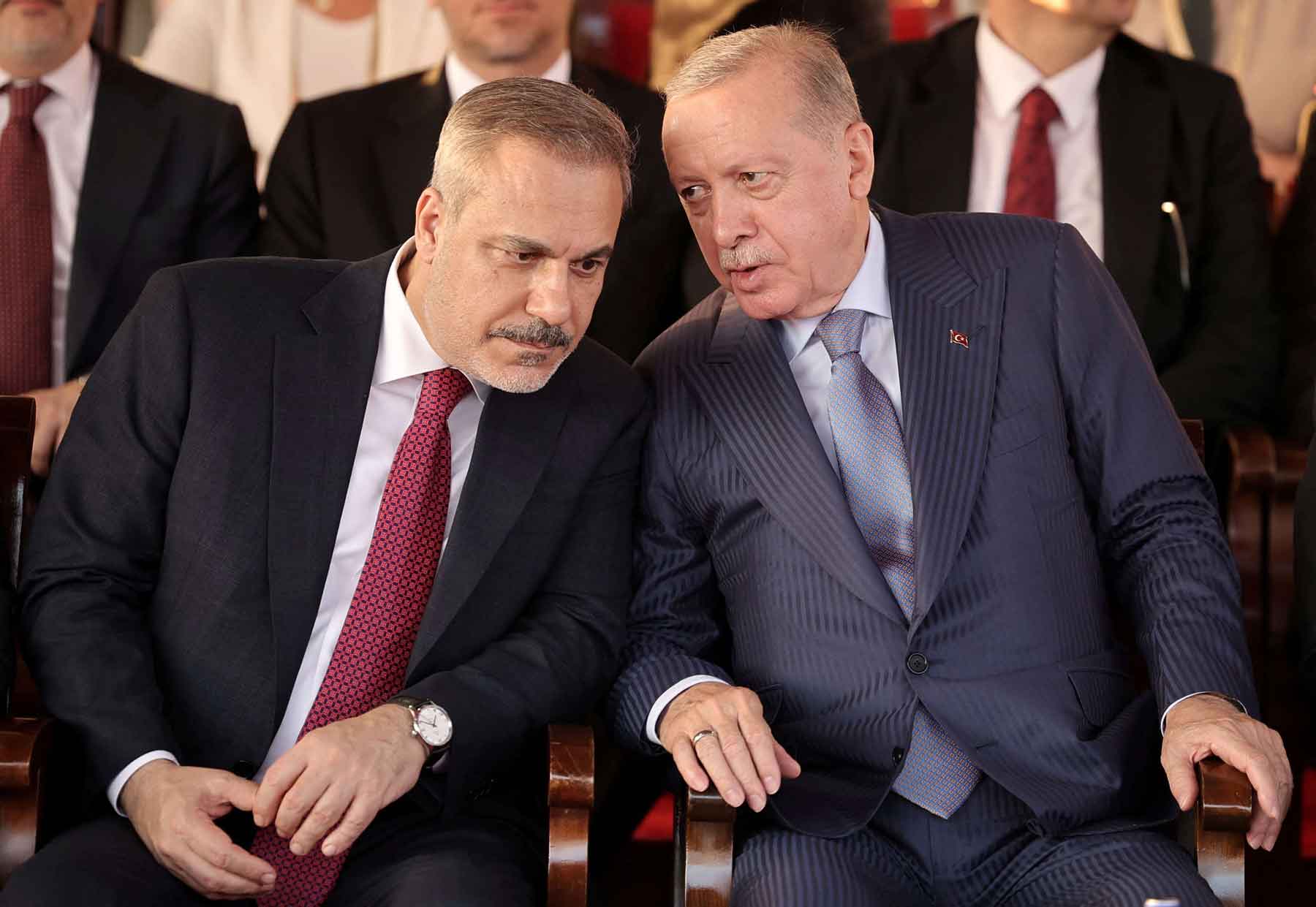
Turkish President Recep Tayyip Erdogan and Turkish Foreign Minister Hakan Fidan attend a military parade in the Turkish-controlled northern Cyprus, in the divided city of Nicosia, July 20, 2025.
Media arrests expose power struggle inside Erdogan’s ruling party
For years, reports have suggested that Fidan sought to build an independent media base, drawing on his intelligence background and a network of loyalists.
Thursday 18/12/2025
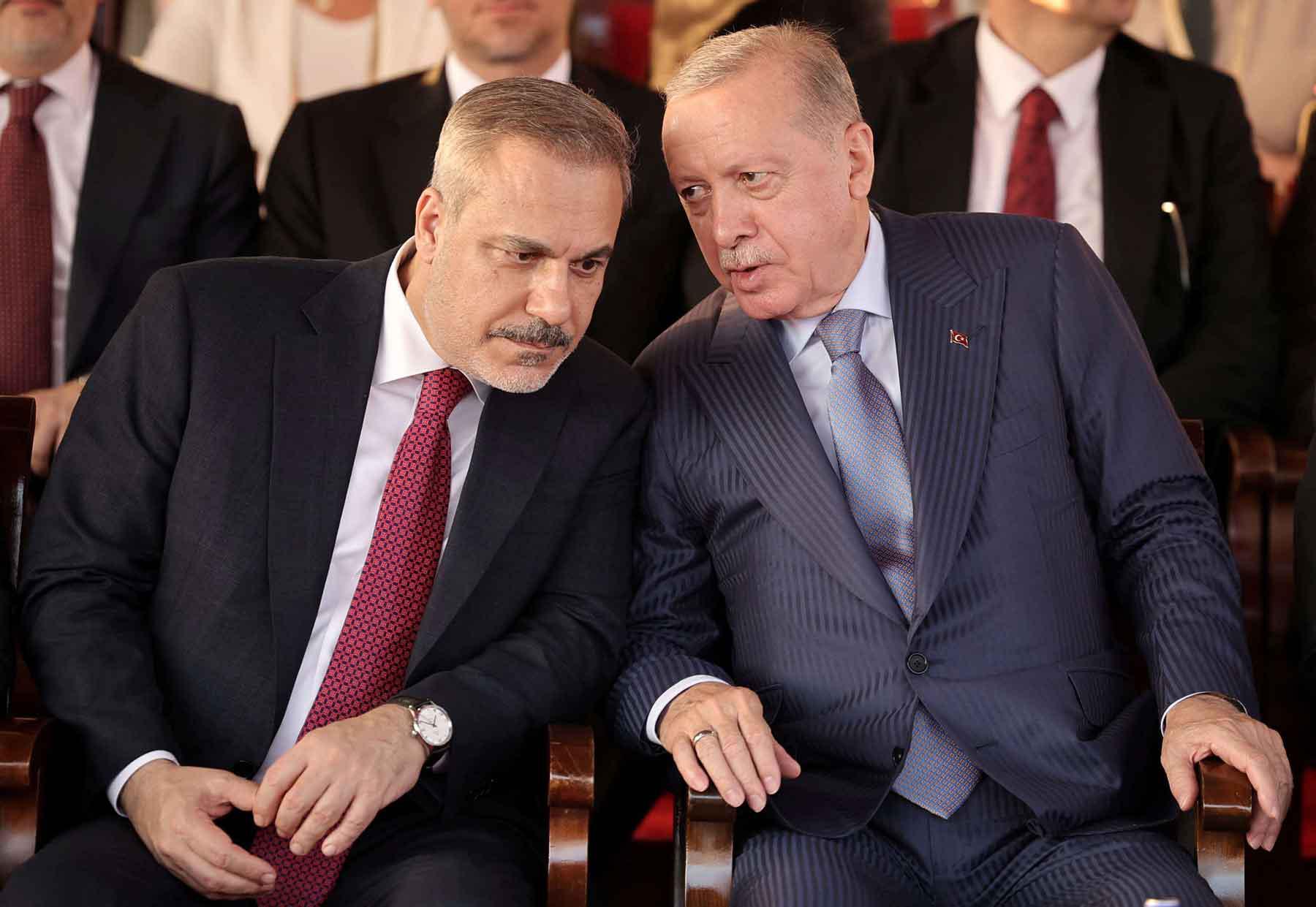
Turkish President Recep Tayyip Erdogan and Turkish Foreign Minister Hakan Fidan attend a military parade in the Turkish-controlled northern Cyprus, in the divided city of Nicosia, July 20, 2025.
ANKARA –
A routine criminal probe into drugs and alleged misconduct has rapidly morphed into a high-stakes political battle, becoming a vivid symbol of the fierce power struggles brewing within Turkey’s ruling Justice and Development Party (AKP) as President Recep Tayyip Erdogan’s long-standing dominance shows signs of waning.
At the centre of the storm is Mehmet Akif Ersoy, former editor-in-chief of the Haberturk television channel, whose arrest has unleashed political shockwaves that far outweigh the legal accusations levelled against him. Analysts say the affair illustrates how internal rivalries once carefully managed behind closed doors are now breaking into the open, marking a more volatile and unforgiving phase in Turkish politics.
The operation began on December 5, when Istanbul gendarmerie units raided the homes of three prominent television presenters. Small quantities of narcotics were reportedly found, leading to their detention and compulsory medical testing, including forensic examinations for traces of drugs in blood and hair samples.
Four days later, the investigation expanded significantly. Istanbul’s public prosecutor issued arrest warrants for eight suspects on charges of “purchasing, possessing or using narcotic substances, or providing premises for their use.” Those named included Ersoy, Haberturk’s foreign news editor Elif Kilinc and several other media figures.
Ersoy was detained at his workplace, while prosecutors said inquiries were continuing into four additional suspects still being sought.
While the legal case itself may not result in heavy sentences, its political impact has been immediate and profound. Ersoy is no ordinary journalist. Deeply embedded in Islamist political networks, fluent in Arabic and educated in religious schools abroad, he has long been associated with media structures close to Turkey’s Islamist establishment.
His arrest, followed by a sustained and hostile media campaign led by the pro-government daily Sabah, is widely seen by observers as a form of political execution, aimed less at enforcing the law than at delivering a stark warning to rivals within the ruling party.
The timing has only sharpened its significance. As discussions about Erdogan’s eventual departure grow more frequent in private political circles, tensions have intensified among figures manoeuvring for position in a post-Erdogan order. In such an atmosphere, analysts say, no senior figure moves openly unless they believe the president’s authority has begun to wane.
Behind the scenes, Ersoy is widely viewed as a catalyst rather than the ultimate target. Political insiders say allies initially sought to contain the fallout and prevent the affair from escalating. Once the fuse was lit, however, Ankara began bracing for counter-moves.
Attention has increasingly focused on Foreign Minister Hakan Fidan, a former intelligence chief widely regarded as a potential successor to Erdogan. Although Fidan has publicly insisted that he is focused solely on his diplomatic responsibilities, scepticism remains strong within political circles.
For years, reports and analyses have suggested that Fidan sought to build an independent media base, drawing on his intelligence background and a network of loyalists. Such ambitions are said to have alarmed Erdogan’s inner family circle, particularly his son Bilal Erdogan, who is widely seen as a key guardian of the ruling family’s dominance over the media landscape.
Media reports dating back to April 2025 pointed to efforts to revive Flash TV under figures linked to Fidan, framing the move as a direct challenge to the Turkuvaz media group, which is closely aligned with the Erdogan family. According to those accounts, Bilal Erdogan, backed by former interior minister Suleyman Soylu, intervened to block what was perceived as a serious threat to family control over the sector.
For analysts, the confrontation reflects a deeper reality: control of the media remains one of the central pillars of political power in Turkey. Erdogan, they argue, has never hesitated to intervene when influential figures attempt to translate media influence into independent political capital.
Viewed through this lens, the Ersoy affair is less about alleged misconduct than about succession, fear and survival within an elite confronting an uncertain future. What stands out most, observers say, is the erosion of old restraints. After years of mobilising against external enemies, rival factions within the ruling camp now appear increasingly willing to turn on one another, unbound by former ethical or legal limits.
For many Turks, the public downfall of a figure once regarded as a pillar of Islamist respectability has come to symbolise a deeper crisis, not only of power, but of credibility, within the ruling elite itself.
As the prospect of a post-Erdogan era draws closer, few doubt that the confrontation laid bare by this case is merely the opening act.