
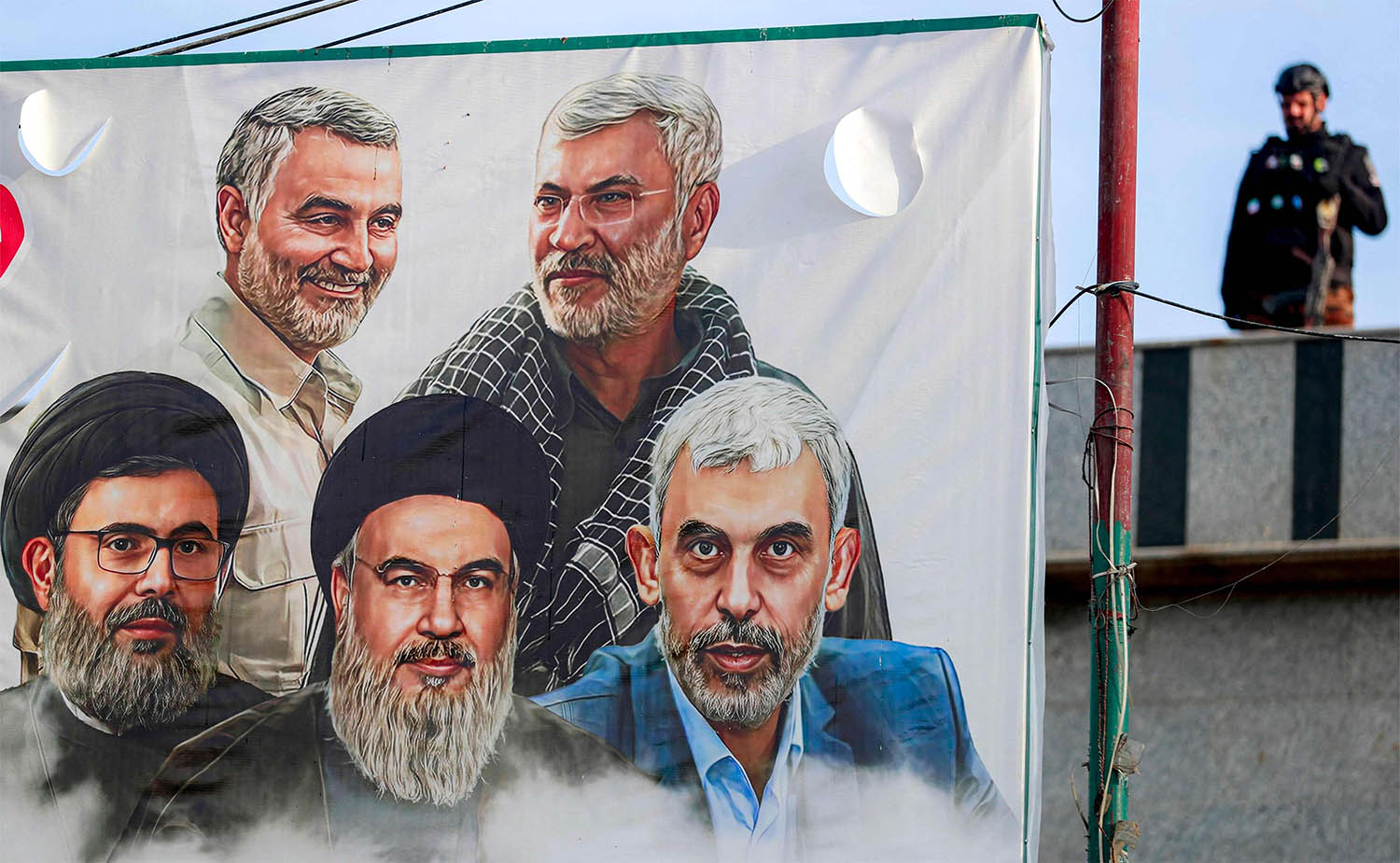
A member of the Iraqi security forces stands near a banner depicting figures of Iran-backed militant groups killed by Israel
The silence of the Resurrection and the cry of battle!... What are the repercussions of the coming war on Iraq and the Kurdistan Region?
As for Iraq, along with the Kurdistan Region, they will be in an extremely sensitive position if war breaks out between Iran and Israel, due to several geographical, political, security, and economic factors.
Monday 08/09/2025
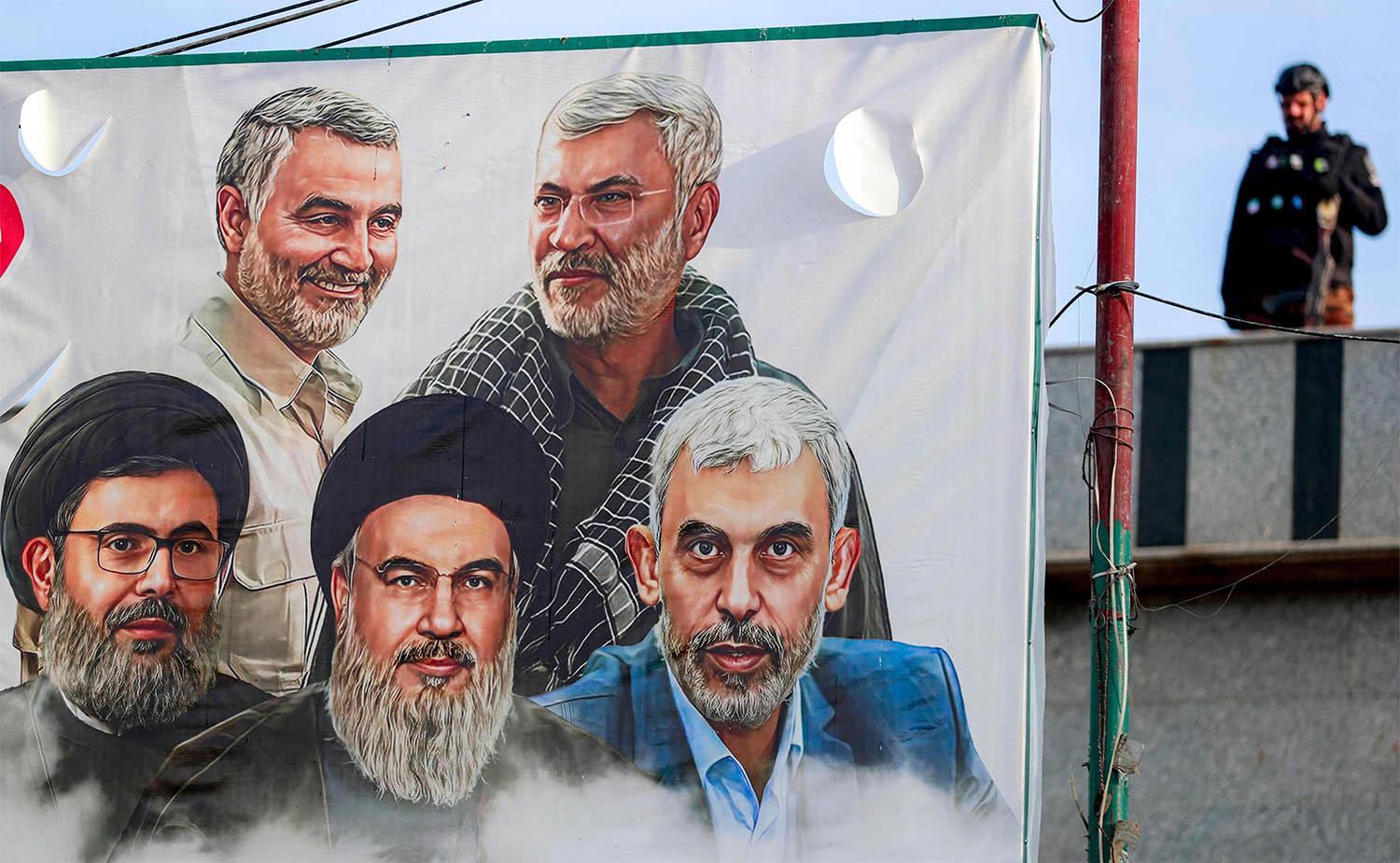
A member of the Iraqi security forces stands near a banner depicting figures of Iran-backed militant groups killed by Israel
At an accelerating pace of events, tensions are once again escalating between Tehran and Tel Aviv, amid clear indicators telling us that the entire region may be on the path to a fierce war, intense fighting, and a near-comprehensive military confrontation looming over vast areas and sweeping through several countries, following the clash of interests in the Middle East. This escalation does not stem from a momentary, immediate disagreement, but from complex political, ideological, and security accumulations stretching back decades. Here, it is worth analyzing some of the active elements and influential considerations that may lead once again to the outbreak of a devastating and direct war between the Hebrew State and the Iranian Wilayat al-Faqih (Guardianship of the Islamic Jurist). We will actively review the most critical regional and international balances crucial to the dynamics of this conflict.
The roots of the conflict between Iran and Israel go back to the beginnings of the Islamic Revolution in Iran in 1979, when Khomeini, against the Shah of Iran since the early days of the Mullahs' revolution, adopted a hostile discourse towards Israel, considering it "the usurping Zionist entity" according to their own vision?.. Since then, Iran's regional policies have evolved to export the Iranian revolution abroad and enhance their influence, extending their intellectual and sectarian hegemony over the region, especially towards some Arab capitals and countries, led by Iraq, Saudi Arabia, Bahrain, Lebanon, Kuwait, and Yemen, but based on their own agendas? On the other hand, Tehran began in the 1980s to support some armed movements like Hezbollah in Lebanon as part of the "Axis of Resistance" led by Iran against the United States, Israel, and their allies in the Middle East. The methodological framework of this party is based on Khomeini's ideology and the Iranian Wilayat al-Faqih. In recent years, Tehran has supported Hamas in Gaza, the Houthis in Yemen, and the Popular Mobilization Forces (PMF) in Iraq, forces considered anti-Israel.
In a different context, Tel Aviv sees Iranian expansion as a serious existential threat, especially with the development of Iran's nuclear program activity. Aiming to weaken the Iranian military structure without engaging in a full-scale war, Israel, prior to the recent war against Iran and over the past years, has launched dozens of devastating missile strikes against Iranian targets in Syria, within what it calls the "battle between the wars."
Recently, as a result of escalating mutual strikes between the two sides, the Palestinian, Lebanese, Yemeni, Iraqi, and Syrian arenas have witnessed military exchanges, where Israel was accused of bombing Iranian sites and its weapons convoys, while Tehran pledged an effective and immediate response. The tools of conflict have evolved to include the cyber and maritime domains as well. Iranian and Israeli ships have been subjected to mysterious attacks in the Red Sea and the Arabian Gulf, indicating a shift of the confrontation to non-traditional spheres.
Meanwhile, Lebanese Hezbollah has intensified its operations on the Israeli border in what is considered a response to Israeli assassinations that targeted its leaders in Lebanon and Syria during the Bashar al-Assad regime. This escalation increases the likelihood of the party engaging in any upcoming war alongside Iran.
With the failure of international negotiations to revive the nuclear deal and the increase in uranium enrichment levels in Iran, Israeli fears have grown. This may push it once again, with American and European blessing, to carry out a devastating preemptive strike to prevent Tehran from acquiring nuclear weapons by all available means, regardless of the sacrifices!?
Between the outbreak of a large-scale, rapidly executed war that burns the region and destabilizes its security and stability, or limited raids and painful missile strikes against precisely identified vital targets, several potential scenarios unfold before us. One scenario involves Israel directing intensive strikes against Iranian nuclear or military facilities, to which Tehran responds through its regional allies, especially in Iraq, Yemen, and Lebanon, without full and direct engagement in the war.
If the mutual responses between the two sides expand, a large-scale war and a full-dimensional confrontation may erupt, encompassing Lebanon, Yemen, Iraq, and possibly Syria, with the participation of major international powers like some European countries and the United States of America, which is a strategic partner of Israel. If military operations exceed red lines that threaten global energy security, international powers like Russia, China, and the European Union may intervene diplomatically in an attempt to contain the escalation.
Although the United States always affirms its commitment to Israel's security, it seems somewhat reluctant to engage in a new war in the Middle East? Russia, meanwhile, always seeks to maintain its influence in Syria and balance its relations between Tehran and Tel Aviv. The Gulf states are divided amongst themselves; some fear Iran's fangs? but they also fear the consequences of a regional war that could reach their borders. It must be said that the conflict between Iran and Israel contains all the elements of explosion: ideological, political, military, and nuclear. With the continued absence of a genuine diplomatic settlement to this moment, war remains a persistent possibility without relent. However, all parties realize that the outbreak of a sweeping, comprehensive confrontation will cost everyone dearly, making the "brinkmanship" scenario the most likely until further notice?.
As for Iraq, along with the Kurdistan Region, they will be in an extremely sensitive position if war breaks out between Iran and Israel, due to several geographical, political, security, and economic factors.
Currently (except for Kurdistan), Iraq is considered politically an area of Iranian influence, particularly through the PMF-linked militias, which may participate in the war directly or indirectly by striking American or Israeli interests in the region. This could expose Iraq to retaliatory Israeli or American attacks.
In this case, Iraqi territory might be used to launch missiles or drones against Israeli or American targets, making some areas inside Iraq a target for direct military response. Israel may target sites, weapons depots, or military bases belonging to Iran-loyal militias deep inside Iraqi territory, affecting the escalation of the war and potentially reigniting sectarian violence or making the country's security climate fragile, especially with the potential for divided stances among Shiite, Sunni, and Kurdish forces?. There is also the possibility of ISIS or other extremist groups exploiting this security vacuum and weakness.
Economically, any major war will affect global oil prices and may disrupt production or export through Iraq, especially if oil pipelines or ports are targeted. This would cause a state of political and economic instability due to sanctions or the existing tension in the region.
Regarding the Kurdistan Region, Tehran might once again accuse the Region of cooperating with the Israeli side, as it did before?, or with the United States, especially given the presence of foreign consulates and offices in the Iraqi Kurdistan Region, partly due to its status as a federal region established in the Iraqi constitution. In the event of war, areas in the Region might be subjected to missile strikes, as happened previously (targeting Erbil by Iran in 2022 and 2024 under the pretext of housing Israeli Mossad headquarters).
If Tehran threatens stability in the Region, this disruption could temporarily negatively impact the economy and foreign investments within the Region, particularly in the energy sector. This conflict might be used as a pretext by some internal and external parties to enhance their security or political influence within the Region.
There is a strong possibility of escalating political disagreements between Erbil and Baghdad in the next stage if the PMF militias launch missile attacks or drone strikes against vital or military installations within the Region. This could lead to the Region being used as a base for an appropriate response and for launching missile strikes against the PMF militias by coalition forces and US forces, especially after the complete withdrawal of the US army from Al-Asad Air Base in Anbar province, Baghdad International Airport, and the Joint Operations Command headquarters, heading towards Erbil and the Kurdistan Region, particularly their positioning at Erbil base. This move might embarrass the Baghdad government (which supports Iranian influence) in front of the Tehran government and push it to adopt politically and economically hardline positions towards the Erbil government, as it does now, and perhaps even more strictly and harshly in the next stage. Based on the available data and field developments according to the current situation, it is expected that the Kurdistan Regional Government will not allow the cities of the Region to turn into military barracks, a source of threat to neighbors, or a base for directing and exchanging military strikes against parties involved in the war. Meaning, Kurdistan will maintain its security and stability at all costs, and the Region will not pose a threat to any party inside or outside the equation.
It is also useful to say that if the war expands into Iraqi territory, the number of displaced people heading towards the Kurdistan Region may increase, creating a multiplied humanitarian and service pressure on the Kurdistan Regional Government.
Finally, we can only say: the coming war will not announce itself with the roar of cannons but will creep in like a long shadow in the evening of fear. It will walk on the edges of politics and smile in the face of diplomacy. But it will hide behind its back a knife of fire.
And the coming war will not start with a soldier's cry. But with the silence of the world... It will be a war without trenches. But with a thousand fronts. A war where not only blood is shed, but where humans are replaced by machines, and consciences are replaced by cutting blades.
Aryan Ibrahim Shawkat is a teacher, writer and journalist
Views expressed in this article may or may not reflect those of Middle East Online.