
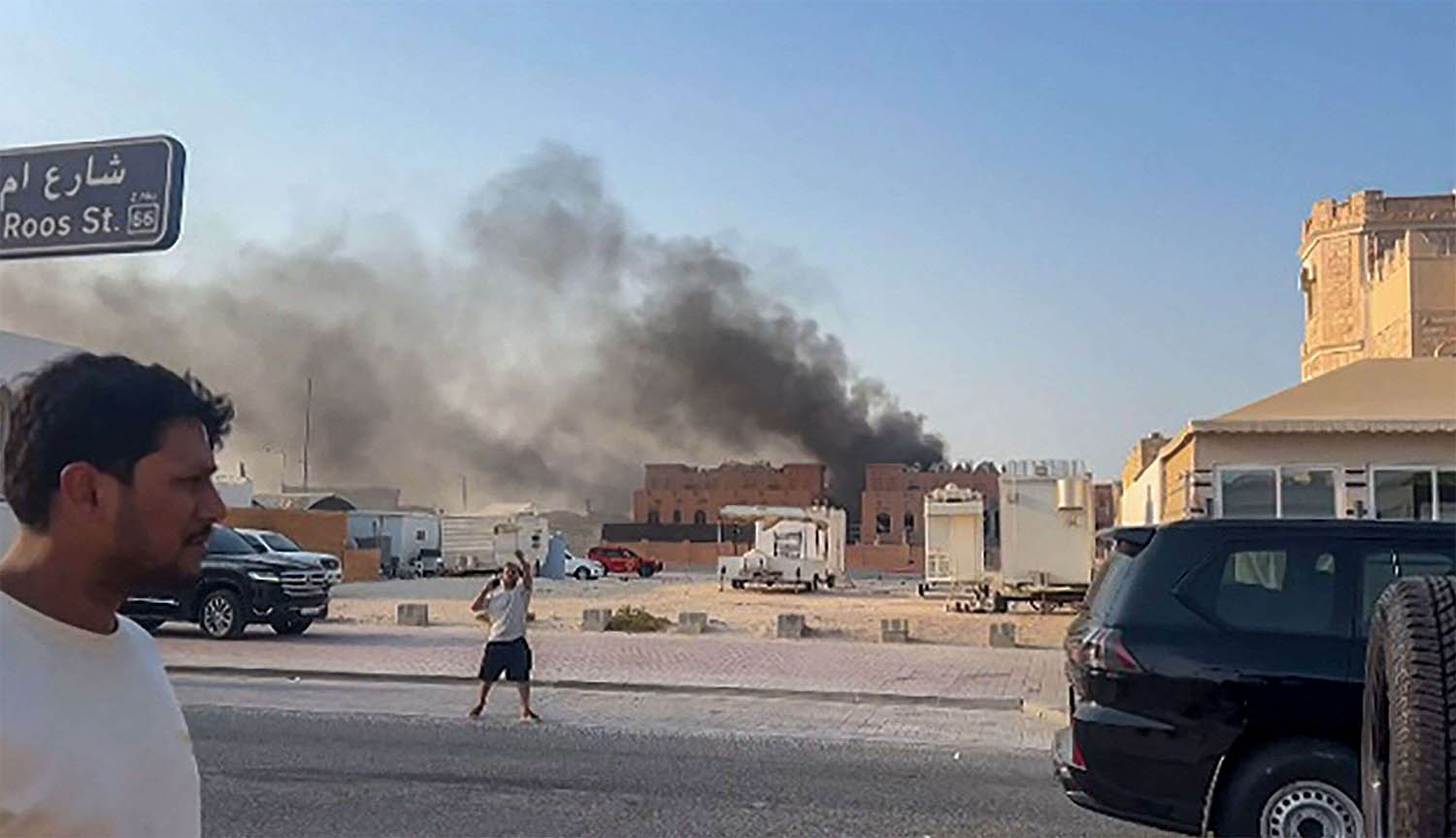
The buildings targeted were places where several senior Hamas leaders either lived or had their offices
Uncontrolled Israel: The biggest threat to world peace
This attack in Qatar is seen as something that could further raise tensions in the Middle East. Israel’s action is being considered a serious threat to regional stability, and it is the first time Israel has carried out a strike in Qatar.
Tuesday 16/09/2025

The buildings targeted were places where several senior Hamas leaders either lived or had their offices
On September 9, in the afternoon, Israel carried out an attack on Qatar’s capital, Doha. Fifteen Israeli fighter jets and more than ten types of munitions, including stand-off missiles and stealth technology, flew 1,800 kilometres from Israel and struck the Katara and West Bay Lagoon areas.
The buildings targeted were places where several senior Hamas leaders either lived or had their offices. More than 40 people were killed in the attack. Hamas claimed that its main negotiating team survived, but five members, including the son of Khalil al-Hayya and a Qatari security officer, were killed.
This attack in Qatar is seen as something that could further raise tensions in the Middle East. Israel’s action is being considered a serious threat to regional stability, and it is the first time Israel has carried out a strike in Qatar.
Immediately after the attack, Qatar increased the monitoring of its airspace, though Qatar Airways flights continued as usual. Prime Minister Sheikh Mohammed bin Abdulrahman Al-Thani warned that the strike could derail Qatar’s efforts to mediate a ceasefire in Gaza. Qatar called the attack “cowardly” and a “gross violation of international law.” Foreign Ministry spokesperson Majed al-Ansari also described it as a threat to Qatar’s sovereignty and the safety of its citizens.
Israeli Prime Minister Benjamin Netanyahu and the Israeli security forces took full responsibility for this attack, saying it was carried out with precise weapons and based on strong intelligence, so that harm to civilians would be minimized.
According to Israel, the Hamas leaders targeted in Doha were responsible for the 7 October 2023 attack and were running the war in Gaza. The Israeli ambassador in the US also said that if any Hamas leaders survived this attack, they will be targeted in the next one. This move is seen as part of Israel's aggressive strategy to completely eliminate Hamas, no matter which country they are in.
However, targeting Hamas leaders in Qatar is considered an unprecedented step because Qatar is a major US ally and a mediator in Gaza ceasefire talks. The US Al-Udeid Airbase, where about 10,000 US soldiers are stationed, is also in Qatar, only 30 kilometres from where Israel carried out the attack. Israel’s aggressive action has increased tensions both regionally and internationally, and has made the peace process in Gaza more complicated. This attack has also weakened US influence in the Middle East and has created concerns for other countries like Turkey.
Many countries around the world have condemned Israel’s aggressive and provocative action. The government of Qatar called the attack a “criminal assault,” strongly condemned it, and described it as a clear violation of international law and the UN Charter. Qatar also supported all measures to defend its sovereignty. Jordan’s King Abdullah II, during a meeting with Palestinian President Mahmoud Abbas, condemned the Israeli attack in Qatar. He also rejected Israel’s attempts to expand settlements in the West Bank and to tighten control over Gaza, while stressing the need for a ceasefire in Gaza, humanitarian aid, and a two‑state solution. The UAE’s Foreign Minister, Sheikh Abdullah bin Zayed, in a meeting with Egypt’s Foreign Minister, also said the attack violated international law and the UN Charter. He appealed for global action to stop Israel’s “aggression. “Egyptian President Abdel Fattah al‑Sisi, in a phone call with Kuwait’s Emir, expressed “full solidarity” with Qatar, calling the attack an unacceptable violation of Qatar’s sovereignty and a breach of international law. Kuwait’s Emir, Sheikh Mishal al‑Ahmad al‑Jaber al‑Sabah, likewise called it a violation of sovereignty and international law.
Iran’s Foreign Minister, Syed Abbas Araghchi, denounced the attack as “terrorist aggression,” expressed solidarity with Qatar, and labelled Israel as an “immediate threat” to both regional and global peace. Tunisia’s Foreign Ministry also condemned the attack as “malicious and vicious,” expressed full solidarity with Qatar, and stressed the need to protect Arab security from Israeli threats. Many countries have also called for an emergency session of the UN Security Council regarding the attack.
Just as many countries around the world were strongly reacting to the recent attack on Qatar, Israeli Prime Minister Benjamin Netanyahu announced that Israeli security forces now control 40 per cent of Gaza. At the same time, the Israeli forces told the remaining people in Gaza to leave the area. The very next day, on September 11, Netanyahu again openly refused to recognize the existence of a Palestinian state.
Speaking at a ceremony in the Ma’ale Adumim settlement in the West Bank, he declared: "There will be no Palestinian state" and "This land belongs to us." This statement came while he was signing a controversial settlement expansion agreement, which many believe is an attempt to divide Palestinian territory.
Netanyahu, a right-wing leader, has long opposed the idea of a two-state solution. His latest statement is also seen as an effort to destroy any possibility of a Palestinian state.
This rejection comes despite the fact that, on humanitarian grounds, Palestinians had once sheltered the very Jews expelled by Hitler from Germany, and today, in the complex and disputed Middle Eastern political situation, 149 countries around the world have already recognized Palestine.
It would not be wrong to say that the right-wing Netanyahu, seen as an enemy of humanity and violator of international rules, wants to impose his own rule of force in Palestine. To protect humanity, the world must come together to stop such cruel Israeli actions.
Tanveer Jafri is an Indian columnist
The views expressed are solely those of the author and may or may not reflect those of Middle East Online.