


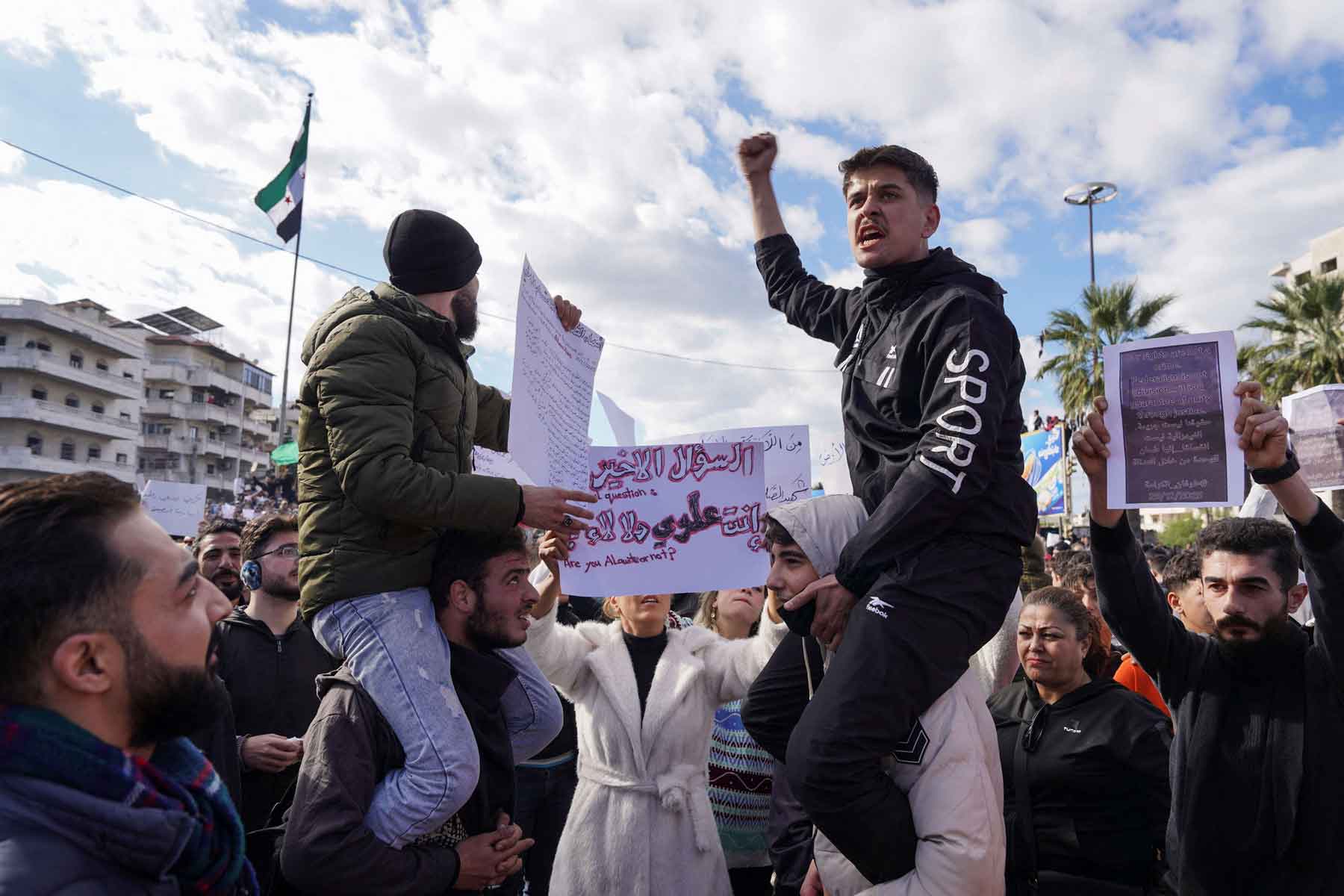
People from the Alawite sect protest as they demand federalism and an end to what they say is the killing and violations against Alawites, in Latakia, Syria, December 28, 2025.
Syria warns of secessionist threat as Alawite protests turn violent
The governor of Tartous, Ahmed al-Shami, said the unrest formed part of efforts by Assad loyalists to exploit incidents to sow chaos and serve foreign agendas.
Monday 29/12/2025
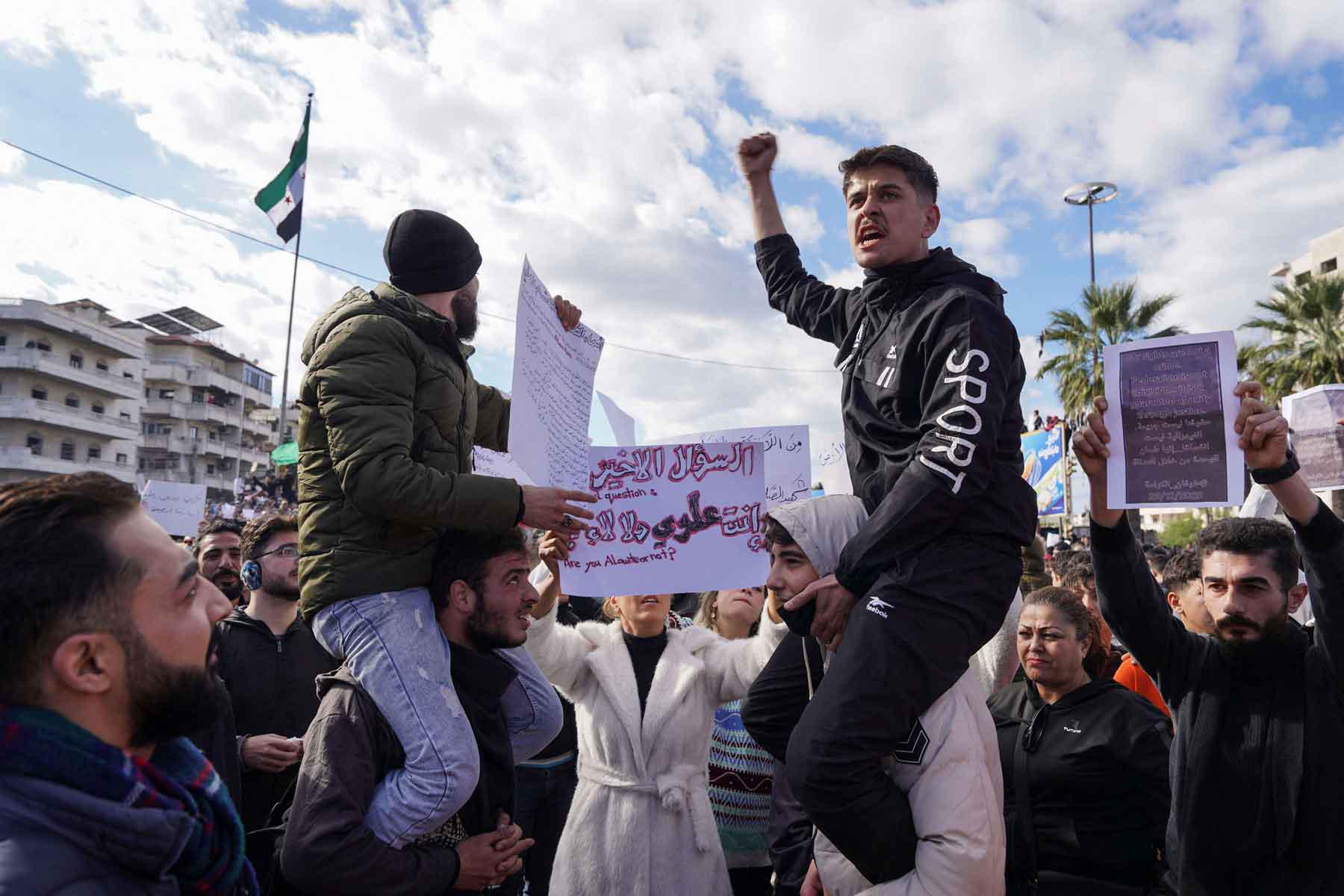
People from the Alawite sect protest as they demand federalism and an end to what they say is the killing and violations against Alawites, in Latakia, Syria, December 28, 2025.
LATAKIA, Syria –
Syria’s authorities warned on Sunday of a growing separatist push by sectarian and ethnic groups seeking to exploit state fragility and internal divisions, after protests demanding federalism and self-determination descended into violence in the country’s coastal Alawite heartland.
Three people were killed and dozens wounded when demonstrations in Latakia spiralled into gunfire, according to provincial officials, in the latest sign of mounting security challenges facing Syria’s new Sunni-led government following the ousting of longtime ruler Bashar al-Assad last year.
The protests, which spread across Latakia and Tartous on the Mediterranean coast as well as Hama and Homs in central Syria, were called by Ghazal Ghazal, head of the Supreme Alawite Islamic Council in Syria and abroad, and featured chants demanding “federalism” and “the right to self-determination.”
Interior Ministry spokesman Nour al-Din al-Baba said the unrest was the direct result of “separatist calls” that threaten Syria’s unity and territorial integrity.
“Internal security forces are acting with a high level of discipline and moral conduct, but the use of live fire is directed against remnants of the defunct regime who target security forces and civilians,” al-Baba told state broadcaster Al-Ikhbariya, stressing that the protests were driven by “calls for secession.”
He said attempts to “mobilise mobs to politically blackmail the state and extract gains at the negotiating table will not succeed.”
Authorities said security measures were tightened during the demonstrations, which saw anti-government slogans raised. In Latakia city, at least three people were killed and around 60 injured in assaults linked to the protests, according to official figures.
Earlier on Sunday, the defence ministry announced that army units had entered central areas of Latakia and Tartous “after an escalation in attacks by outlawed groups against civilians and security forces.”
Al-Baba said the army’s role along the coast was to restore stability in full coordination with internal security forces, adding that recent violence, including a deadly mosque bombing in Homs, had targeted “several components, not one single community.”
“There are certain heads orchestrating what is happening to harm the Syrian people in the coastal region,” he said, without naming them. “Bashar al-Assad has fallen, sectarian rule has fallen, and time will not turn back.”
The governor of Tartous, Ahmed al-Shami, said the unrest formed part of efforts by Assad loyalists to exploit incidents to sow chaos and serve foreign agendas.
“Some external actors have been working since the fall of the former regime to spread rumours and incite unrest, trying to portray the coast as lawless through calls for protests and sit-ins,” he told Al-Ikhbariya.
Al-Shami accused Ghazal of exploiting last week’s bombing of a mosque in Homs, which killed eight people in a predominantly Alawite neighbourhood, to call for demonstrations aimed at destabilising the country at a time when the region also faces threats from Islamic State militants.
Peaceful protest was a guaranteed right, he said, but warned that using demonstrations to open fire, throw explosives or provoke disorder threatened security and stability.
The Latakia province media office said that thousands of Alawite protesters gathered in Azhari Square in Latakia city to demand decentralised governance and the release of thousands of Alawite detainees. About two hours into the rally, gunshots rang out from an unidentified location, triggering panic as security forces fired into the air and demonstrators carried the wounded away.
A written statement said three people were killed and more than 40 wounded, without specifying whether all casualties occurred in the square or in nearby towns where protests were also under way.
State news agency SANA reported that one member of the security forces was killed by gunfire from what it described as “armed remnants of the former regime”, adding that civilians and security personnel were wounded by unknown assailants near Azhari Square.
“We came to demand our dignity, a living, we came to demand political federalism just like big states such as America, Germany and the (United Arab) Emirates,” said protester Salman Mansour. “We came to ask for our right of living after we were killed in our lands.”
Another demonstrator, Nisreen Khazem, said: “We will keep asking for federalism for our dignity. They say we hate each other ... no!”
Syria has seen repeated bouts of sectarian bloodshed since Assad, who hailed from the Alawite minority, was ousted in December 2024 after a rebel offensive that ended more than two decades of his rule. In March, more than 1,000 Alawites were killed following a failed uprising by Assad loyalists that triggered revenge attacks by forces aligned with the new authorities.
The coastal region was a stronghold of senior Assad-era military and intelligence figures, and the government has made securing the area a priority as it seeks to dismantle networks linked to the former regime while avoiding collective punishment.
Ghazal, who is known for close ties to the former Baathist regime, compared last week’s mosque bombing in Homs to “what the Jews suffered under Nazism” and called for international protection and political federalism, remarks that have drawn sharp condemnation from Syrian officials.
The government says it remains committed to restoring security and pursuing those responsible for violence, while rejecting any moves that could fragment the country at a time when Syria is struggling to rebuild after years of war.