

A remarkable continuity of bilateral relations
Trade and regional security top agenda for UAE president’s India visit
India and the UAE have seen bilateral trade exceed $100 billion, while the Indian community in the UAE, numbering more than 4.3 million, remains central to people-to-people links.
Monday 19/01/2026
A remarkable continuity of bilateral relations
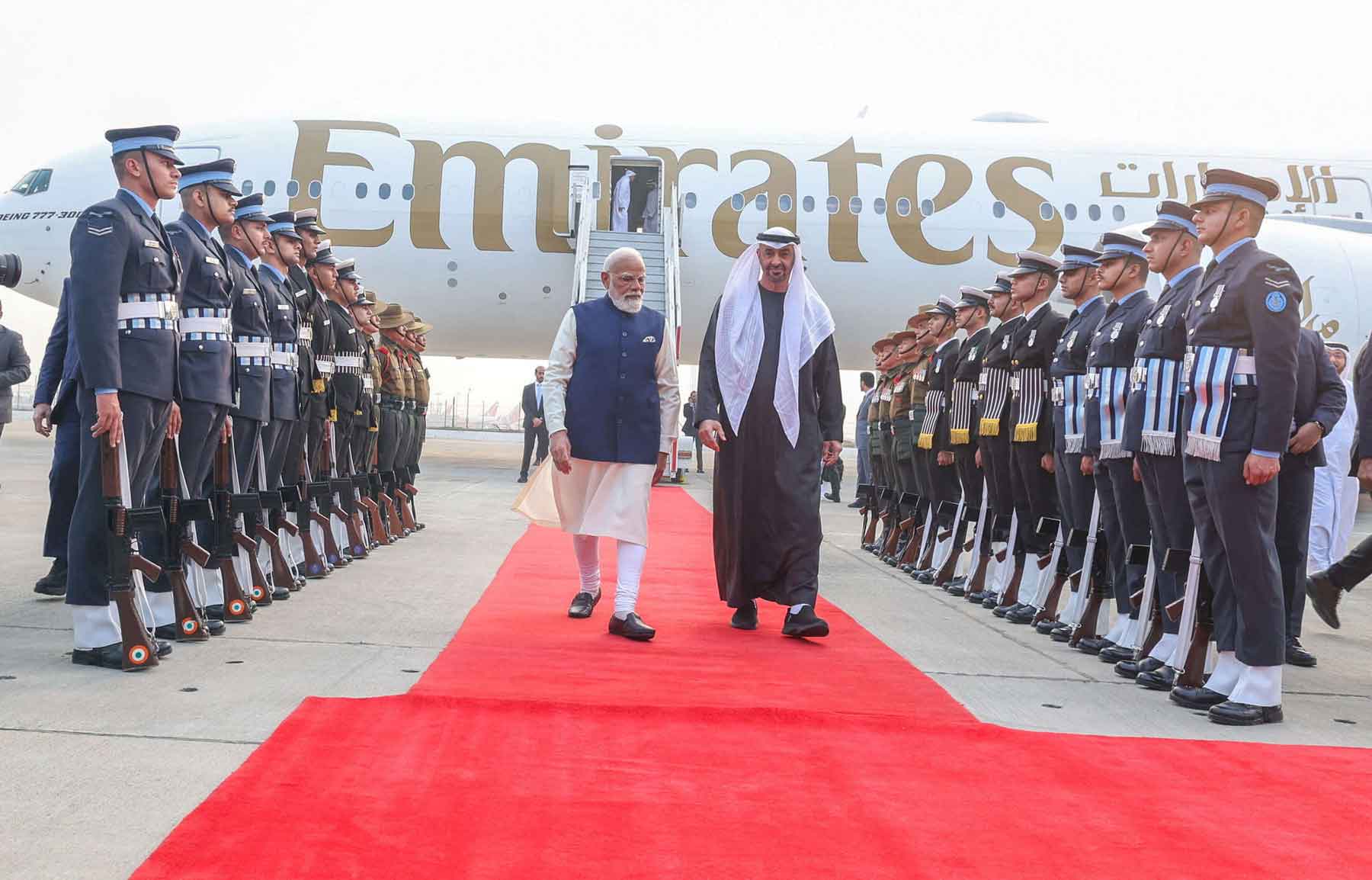
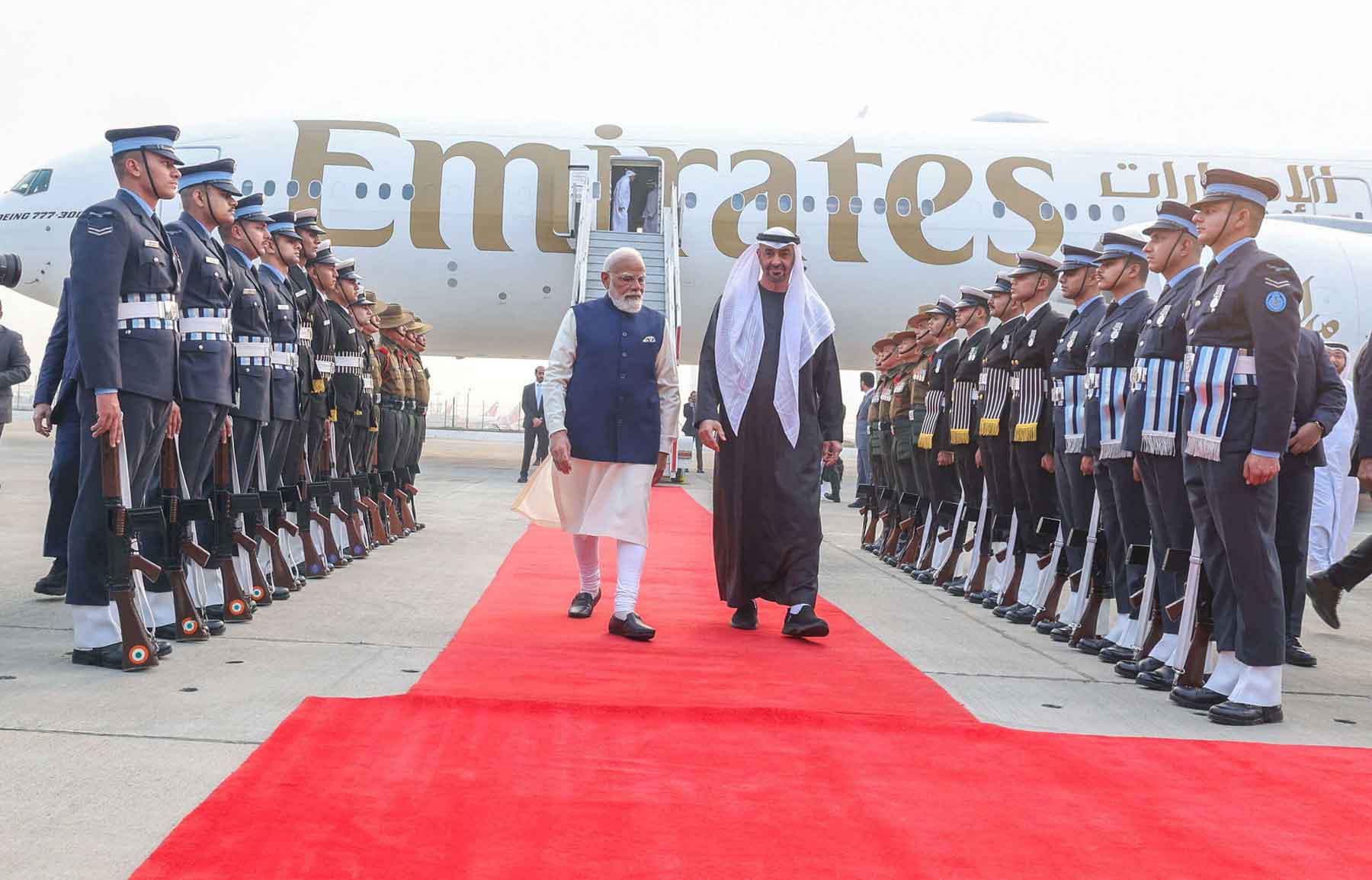
NEW DELHI – UAE President Sheikh Mohamed bin Zayed Al Nahyan arrived in New Delhi on Monday for a brief but high-level official visit, personally welcomed at the airport by Indian Prime Minister Narendra Modi. The two-hour visit, undertaken at the invitation of Prime Minister Modi, underscores the deep and multifaceted partnership between India and the UAE, a relationship grounded in centuries-old cultural ties and bolstered by rapidly expanding economic and strategic engagement.
This marks Sheikh Mohamed’s third official visit to India since assuming the presidency and his fifth visit to the country in the past decade, reflecting the remarkable continuity and momentum of bilateral relations. Previous visits include trips in September 2023 and January 2024 as president, and earlier journeys in 2016 and 2017 as Crown Prince of Abu Dhabi. The UAE president’s latest trip coincides with heightened developments in West Asia, amid ongoing unrest in Iran, evolving Gulf dynamics and US-led initiatives in the region, including the next phase of the Gaza Peace Plan.
India and the UAE have seen bilateral trade exceed $100 billion in 2024-25, while the Indian expatriate community in the UAE, numbering more than 4.3 million, or roughly 35 percent of the country’s population, remains central to people-to-people links. The UAE is India’s third-largest trading partner, while India ranks as the UAE’s second-largest, with imports reaching $63 billion and exports $37 billion in FY 2024-25. Both nations have strengthened economic ties under the Comprehensive Economic Partnership Agreement (CEPA) signed in February 2022, while UAE foreign direct investment in India has surpassed $22 billion since 2000, with $4.3 billion invested in 2024-25 alone. Long-term commitments include a pledged $75 billion in Indian infrastructure projects, highlighting Abu Dhabi’s confidence in India’s growth trajectory. Initiatives such as the India-Middle East-Europe Economic Corridor, launched at the 2023 G20 India Summit, reflect the shared ambition of positioning both nations at the centre of global trade and connectivity.
Energy and environment form key pillars of bilateral engagement. The UAE is among India’s leading suppliers of crude oil, LNG, and LPG, supporting the country’s energy security. Both nations are also collaborating on green energy initiatives, including an MoU on green hydrogen signed in January 2023, membership in the Global Biofuels Alliance, and the launch of India’s Global Green Credit Initiative at COP28 in Dubai in December 2023.
Defence cooperation has intensified over recent years, with regular joint exercises and institutional coordination. The India-UAE Defence Partnership Forum has facilitated collaboration through the 13th Joint Defence Cooperation Committee in July 2024, alongside army and naval exercises such as Desert Cyclone-II and Gulf Waves, and participation in multinational exercises including MILAN, Tarang Shakti, and Desert Flag. The Desert Knight Exercise in January 2024, involving India, the UAE, and France, demonstrated the expanding scope of defence engagement beyond bilateral frameworks. Earlier this month, Chief of Army Staff General Upendra Dwivedi visited the UAE to strengthen military-to-military ties, receiving briefings from senior UAE Armed Forces leaders and visiting key installations.
The visit takes place amid complex regional developments. Sheikh Mohamed’s arrival coincides with the US preparing the next phase of the Gaza Peace Plan and ongoing unrest in Iran, where protests have prompted international concern and increased diplomatic activity. At the same time, differences in Gulf alignments, particularly between Saudi Arabia and the UAE over Yemen, Sudan, and energy strategy, have added nuance to the regional security environment. Reports of a potential Saudi-Pakistan-Turkey trilateral security framework further illustrate the shifting geopolitical dynamics that India and the UAE must navigate.
The president’s visit builds on a series of recent high-level exchanges, including visits by Abu Dhabi Crown Prince Sheikh Khaled bin Mohamed bin Zayed in September 2024 and Dubai Crown Prince Sheikh Hamdan bin Mohammed bin Rashid Al Maktoum in April 2025, as well as visits by Indian leaders to the UAE. External Affairs Minister S. Jaishankar’s December 2024 trip for the 16th India-UAE Joint Commission Meeting and the fifth India-UAE Strategic Dialogue underscored ongoing engagement across trade, investment, defence, energy, technology, education, and cultural exchanges.
Educational and cultural ties continue to strengthen the bilateral relationship. IIT Delhi’s Abu Dhabi campus opened in September 2024, IIM Ahmedabad’s branch campus followed in September 2025, and the Indian Institute of Foreign Trade signed an MoU for a Dubai campus in October 2024. Over 100 Indian curriculum schools operate in the UAE, while cultural initiatives, from yoga to cinema and religious landmarks, have deepened community connections. The Ahlan Modi event in February 2024, attended by 40,000 people, exemplifies the enduring people-to-people linkages that underpin strategic relations.
During his brief stay, Sheikh Mohamed is expected to hold bilateral talks with the Indian prime minister to chart the next phase of India-UAE cooperation, encompassing strategic, economic and cultural domains, while exchanging perspectives on regional and global developments.