



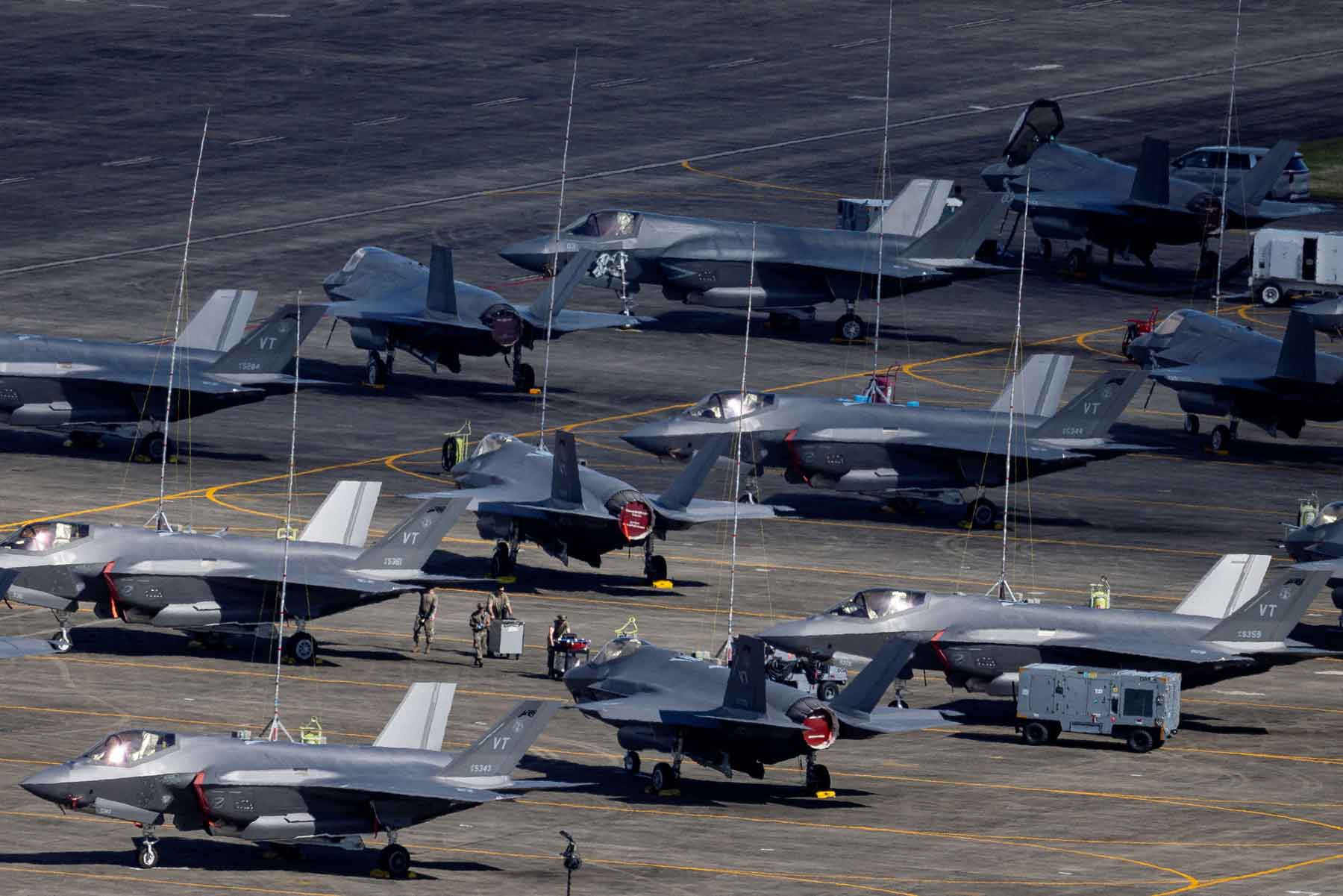
US Air Force F-35A and F-35B Lightning II fighter jets sit parked at the former Roosevelt Roads naval base, in Ceiba, Puerto Rico, December 29, 2025.
Trump floats F-35 jet sale to Turkey as Ankara signals NATO reset
Turkey appears eager to repair ties with NATO partners and regain access to advanced US military technology.
Tuesday 30/12/2025
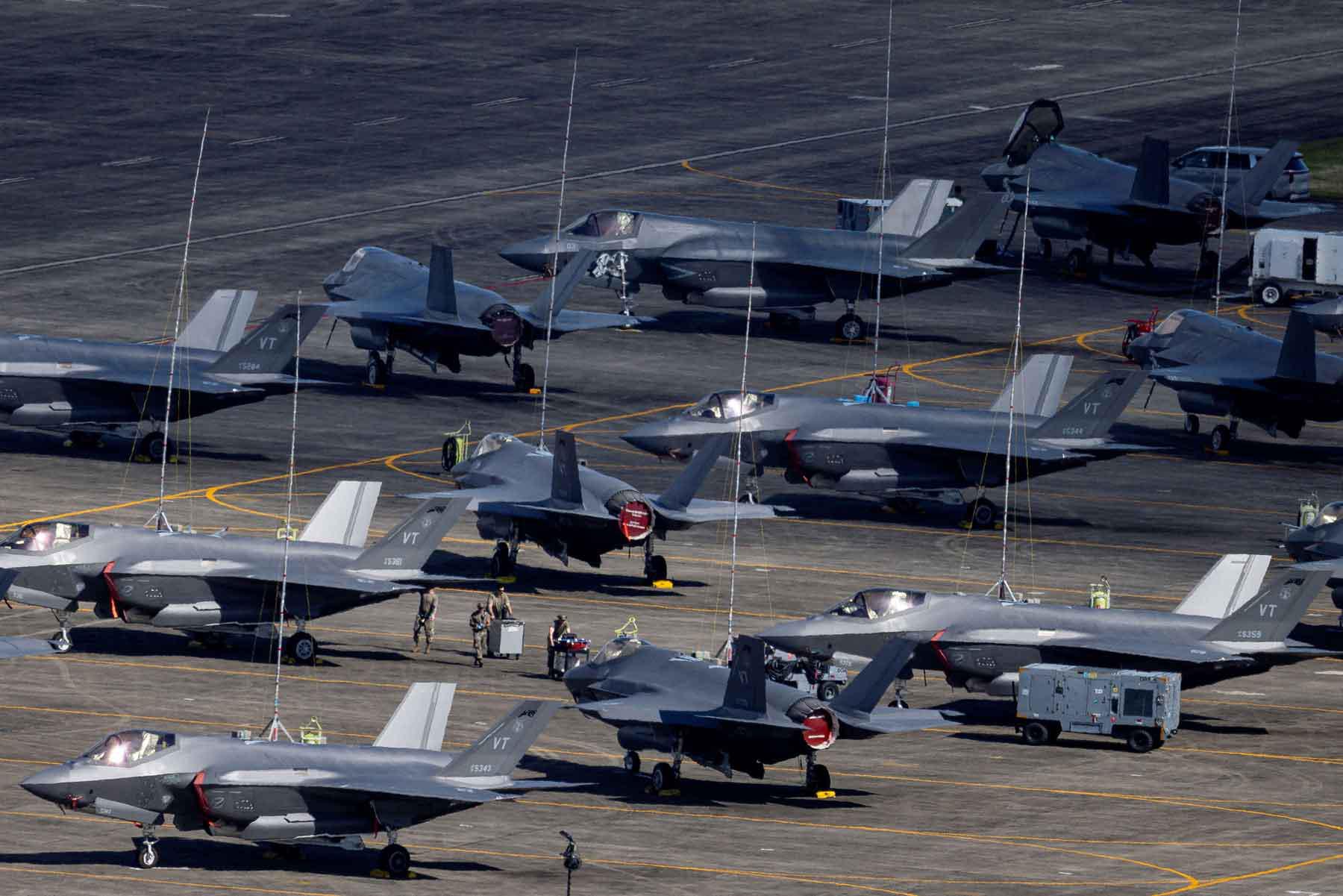
US Air Force F-35A and F-35B Lightning II fighter jets sit parked at the former Roosevelt Roads naval base, in Ceiba, Puerto Rico, December 29, 2025.
PALM BEACH, United States –
US President Donald Trump said on Monday that he was seriously considering selling advanced F-35 fighter jets to Turkey, reopening a long-running dispute between Washington, Ankara and Israel over military balance and alliance politics in the Middle East.
Trump’s comments came during a meeting with Israeli Prime Minister Benjamin Netanyahu at the US president’s Florida club, where the Israeli leader made clear his firm opposition to any such deal.
“We’re thinking about it very seriously,” Trump said when asked whether his administration would approve the sale of the top-end stealth aircraft to Turkey.
The United States removed Turkey from the multinational F-35 programme in 2019 after Ankara went ahead with the purchase of Russia’s S-400 air defence system, a move Washington said compromised NATO security and risked exposing sensitive Western military technology to Moscow.
Despite that rupture, Trump has maintained warm personal relations with Turkish President Recep Tayyip Erdogan, even as Erdogan has repeatedly condemned Israel’s military campaign in Gaza in the strongest terms. Asked about tensions between Israel and Turkey, Trump dismissed the risk of confrontation, describing Erdogan as “a very good friend.”
“We’re not going to have a problem,” Trump said. “Nothing’s going to happen.”
Israeli officials have long argued that providing Turkey with F-35 jets would alter the regional military balance, particularly at a time of heightened rivalry between Ankara and Tel Aviv over war-ravaged Syria, which borders both countries. Israel has also sought to preserve its long-standing qualitative military edge, a principle embedded in US defence policy.
During his first term, however, Trump approved the sale of F-35 jets to the United Arab Emirates after Abu Dhabi normalised relations with Israel. He has also more recently expressed support for supplying the aircraft to Saudi Arabia, despite similar concerns raised in Washington over regional stability and Israel’s security advantage.
Turkey, for its part, appears eager to repair ties with NATO partners and regain access to advanced US military technology. Ankara has reportedly explored options to offload its Russian-made S-400 missile systems in an effort to placate Washington and remove a key obstacle to rejoining the F-35 programme.
In 2017, Turkey purchased several S-400 surface-to-air missile batteries from Russia for around $2.5 billion after failing to secure US Patriot systems on acceptable terms. The deal triggered US sanctions and Turkey’s exclusion from the F-35 project, dealing a significant blow to its air force modernisation plans.
According to reports cited by Bloomberg News, Erdogan recently asked Russian President Vladimir Putin to buy back the S-400 systems during talks in Turkmenistan, though the Kremlin has denied that the issue was formally raised. Other media reports have suggested that Moscow itself floated the idea of repurchasing the systems as it seeks to replenish domestic air defence stocks amid the war in Ukraine.
The S-400 systems have reportedly proved costly to maintain and remain only partially operational. At the same time, Turkey has accelerated work on its own indigenous air defence initiative, known as the “Steel Dome”, to reduce reliance on foreign suppliers, particularly Russia.
US pressure on Ankara has continued. Washington has repeatedly stated that Turkey cannot retain the Russian missile systems while seeking access to the F-35. US Ambassador to Turkey Tom Barrack said last week that discussions were ongoing, reiterating that the missiles remain incompatible with NATO defence architecture.
Turkey’s Ministry of National Defence confirmed that talks aimed at lifting sanctions and resolving obstacles to F-35 procurement were continuing, stressing the importance of addressing the issue “within the spirit of alliance” through dialogue and consultation.
Turkey has been a NATO member since 1952 and possesses the alliance’s second-largest military by personnel. Yet it has pursued a delicate balancing act, maintaining cooperation with Russia in energy and regional diplomacy while also fulfilling NATO security obligations, including shooting down a Russian warplane in 2015 after it allegedly violated Turkish airspace.
Whether Trump’s renewed openness to an F-35 sale translates into concrete policy remains uncertain. Any deal would face resistance in Congress and strong objections from Israel, while raising broader questions about NATO cohesion, US-Russia rivalry, and the future balance of power in the Middle East.