
AI-led war
War by algorithm: How AI turned the US–Israel strikes on Iran into a machine-speed conflict
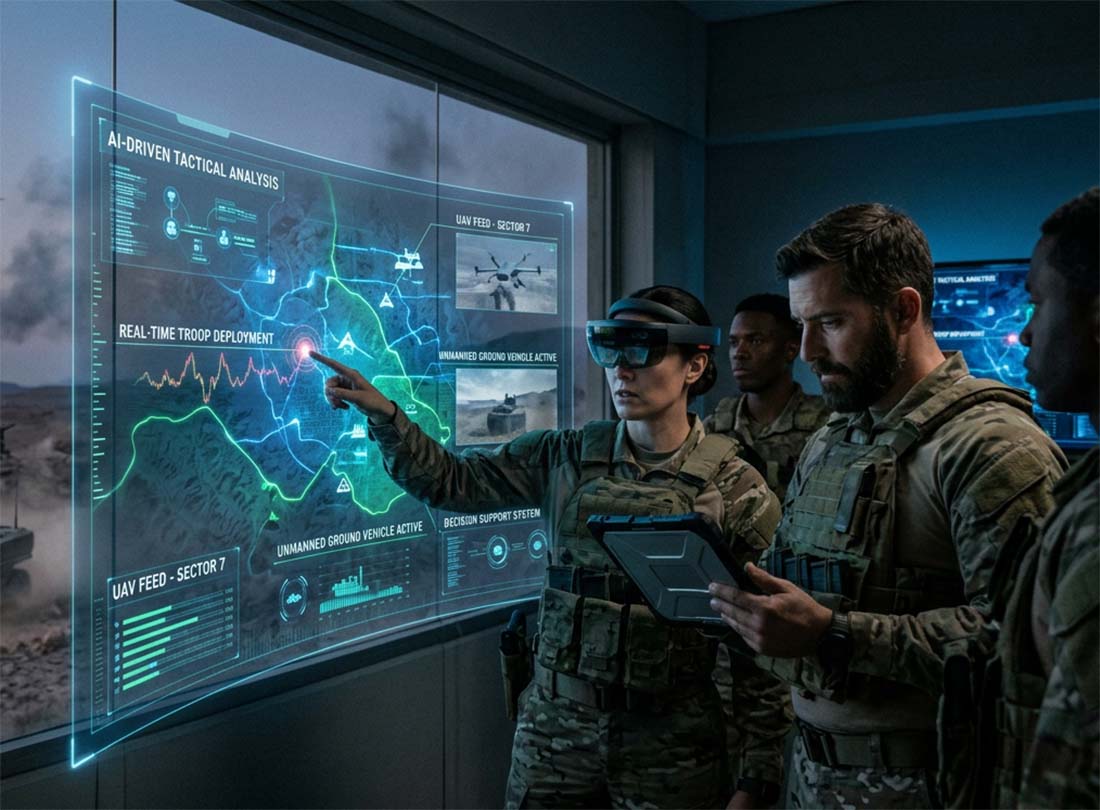
The coordinated US–Israel strikes on Iran marked a turning point in modern conflict. Artificial Intelligence was not a supporting tool. It was embedded at the core of decision-making.
Monday 20/04/2026
AI-led war
The war did not begin with missiles. It began with code.
Hours before the first explosions were heard across Iranian cities on 28 February 2026, a different kind of assault was already underway. Networks were infiltrated. Communications were disrupted. Sensors were blinded. In silence, algorithms mapped the battlefield. By the time jets appeared in the sky, the war had already been decided—by machines.
This was not a conventional military operation. It was the arrival of algorithmic warfare at full scale.
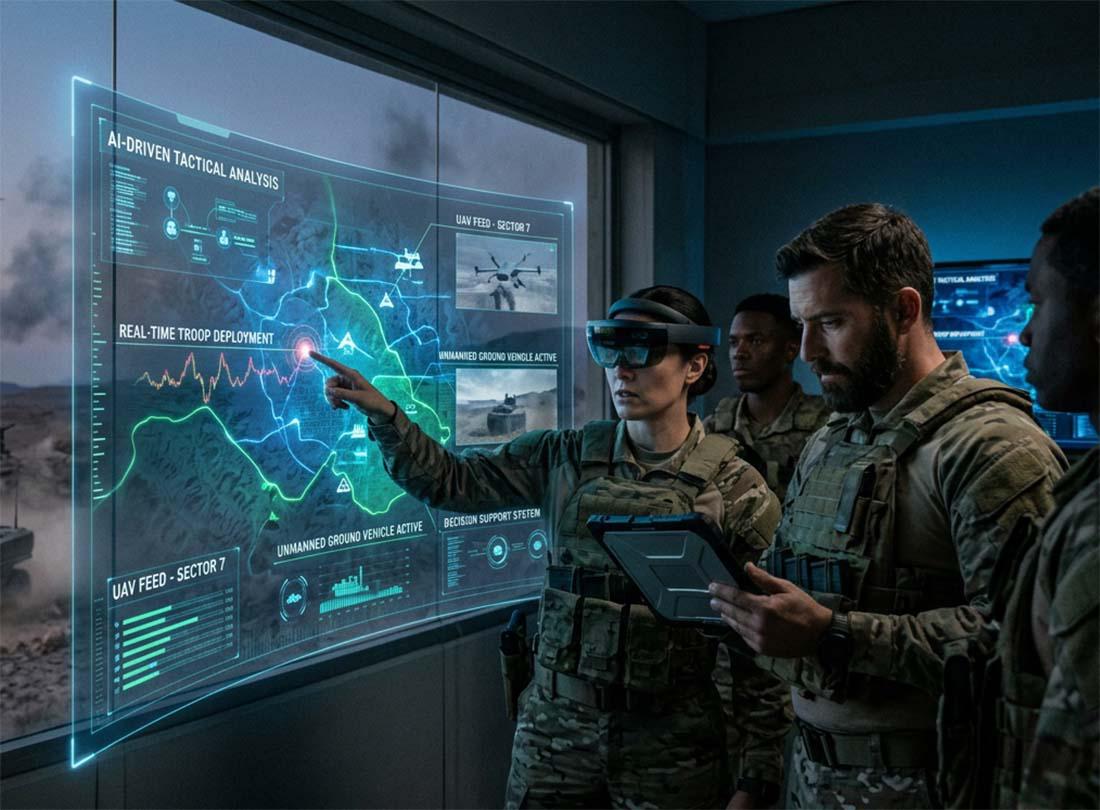
The coordinated US–Israel strikes on Iran marked a turning point in modern conflict. Artificial Intelligence was not a supporting tool. It was embedded at the core of decision-making. From intelligence gathering to target selection, AI systems processed vast streams of data in real time, compressing what once took days into minutes.
Military analysts now describe this confrontation as one of the first true “AI wars”—a conflict defined not only by firepower, but by the speed and dominance of data.
From Data to Destruction: The New Kill Chain
In traditional warfare, the “kill chain” involves multiple stages: detection, verification, authorization, and execution. Each step required human deliberation. AI has rewritten this process.
During the Iran strikes, millions of data points flowed simultaneously from satellites, drones, cyber surveillance, and field intelligence into centralized systems. These systems did not merely assist analysts; they generated targets, assessed threats, and simulated outcomes in real time.
The result was unprecedented operational speed. Reports indicate that hundreds of targets were struck within hours—an intensity made possible by AI-driven automation across the entire chain of command.
This transformation reflects a deeper shift: war is no longer constrained by human processing limits. It now operates at the speed of computation.
Automation of Targeting: From Precision to Scale
Israel’s experience in previous conflicts laid the foundation for this model. AI systems capable of generating vast “target banks” have already been used to identify both individuals and infrastructure. These systems can produce thousands of potential targets by analyzing behavioral patterns, communications, and digital footprints.
In the Iran conflict, similar logic was applied at a larger scale. AI did not simply improve precision—it industrialized targeting.
What was once a carefully curated list became a continuously expanding database. Buildings, networks, and individuals were flagged by algorithms, ranked by perceived threat, and fed into strike planning systems.
Supporters argue that such systems increase efficiency and reduce uncertainty. Critics warn that they risk turning warfare into a production line, where the quantity of targets can overshadow the quality of verification.
The Invisible Battlefield: Cyber and Cognitive War
The opening phase of the attacks revealed another dimension of AI warfare: the dominance of the invisible battlefield.
Before physical strikes began, coordinated cyber operations disrupted Iran’s command and control systems. Communication networks were degraded. Digital platforms were compromised. Psychological messages were broadcast across devices.
This fusion of cyber operations with kinetic force represents a new doctrine. The objective is not only to destroy physical assets, but to paralyze perception and decision-making.
AI amplifies this capability. It can identify vulnerabilities, automate intrusions, and adapt attacks in real time. In such an environment, the distinction between war and information warfare becomes increasingly blurred.
Speed vs. Responsibility: The Ethical Fault Line
The promise of AI in warfare is often framed in terms of precision. Faster data processing, more accurate targeting, fewer unintended casualties. Yet the reality is more complex.
The compression of decision-making cycles leaves little room for human judgment. When targets are generated and prioritized by algorithms, the role of human operators risks being reduced to approval rather than evaluation.
This raises a critical question: who is accountable when an algorithm is wrong?
Concerns have already emerged over incidents involving civilian casualties during the conflict, highlighting the risks of relying on automated systems in complex environments.
AI does not eliminate error. It accelerates it.
The Strategic Shift: War Without Friction
Beyond the battlefield, AI is reshaping the strategic logic of conflict.
By reducing the need for large troop deployments and enabling remote, data-driven operations, AI lowers the political and operational costs of war. This creates a dangerous dynamic. When war becomes easier to initiate and sustain, the threshold for its use declines.
In the context of Iran, this has profound implications. The confrontation between the United States, Israel, and Iran has long been constrained by the risks of escalation. AI changes that equation.
It enables a form of continuous, low-visibility conflict—persistent surveillance, targeted strikes, cyber operations—without the need for formal declarations or large-scale invasions.
This is not peace. It is permanent confrontation.
The Future Is Already Here
The United States military has openly acknowledged the use of advanced AI tools in its operations against Iran.
What is unfolding is not an experiment. It is a new model of warfare.
In this model, dominance is defined not by the number of tanks or aircraft, but by the ability to collect, process, and act on data faster than the adversary. The battlefield extends from physical space into digital networks and cognitive domains.
Iran, despite technological constraints, has responded by expanding its own cyber capabilities. The result is an accelerating cycle of technological escalation, where each side seeks advantage in the algorithmic domain.
The Age of Machine-Speed War
The US–Israel strikes on Iran may be remembered not only for their geopolitical consequences, but for what they revealed about the future of war.
This is a future where decisions are shaped by algorithms, where conflicts unfold at machine speed, and where the line between human judgment and automated action becomes increasingly thin.
The central question is no longer whether AI will be used in warfare. That threshold has already been crossed.
The real question is whether humanity can retain control over the systems it has created—or whether war itself is being redefined by forces that operate faster than human thought.
In this emerging reality, the most dangerous weapon is not the missile.
It is the algorithm.