

If you can't beat them, join them
An Algerian step that cannot be underestimated
Algeria has a real opportunity to establish a land corridor to the ocean through the Moroccan Sahara; there is no Moroccan problem with that. This requires entering into cooperation with Morocco instead of resorting to a complete boycott of this neighbour.
Friday 13/02/2026
If you can't beat them, join them
The meeting recently held at the US Embassy in Madrid, which centered on the implementation of Resolution 2797 issued on October 31 regarding the Moroccan Sahara, was no ordinary event. The presence of Algeria, represented by Foreign Minister Ahmed Attaf, was significant as it puts things in their proper context: confirming that the conflict over the Sahara is originally a Moroccan-Algerian dispute, while the "Polisario" Front represents nothing more than a tool used by the Algerian regime to justify the war of attrition it has been waging against Morocco for half a century. This war has been waged since Morocco regained its Saharan provinces immediately after the withdrawal of the Spanish colonizer in November 1975.
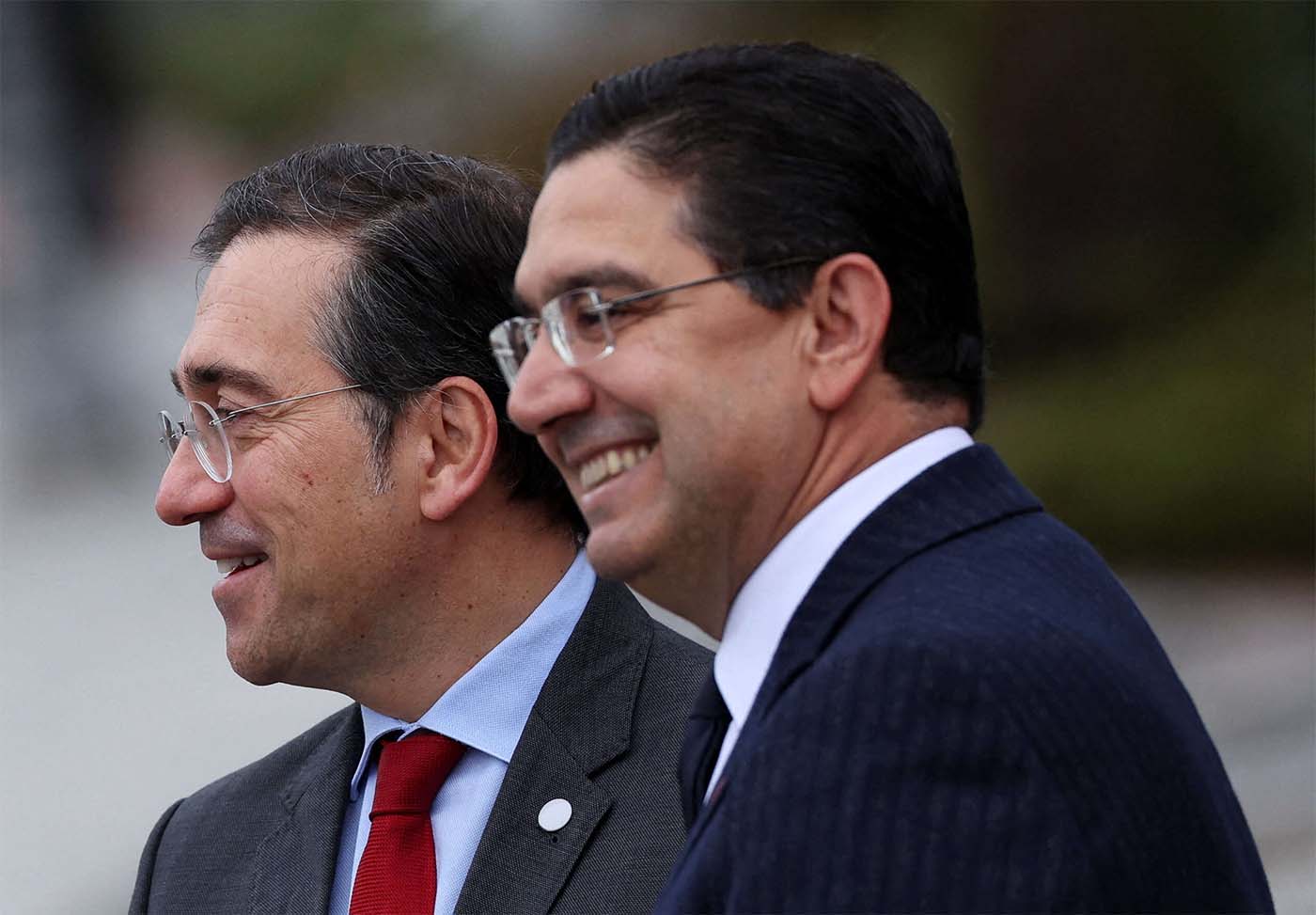
Morocco was represented at the meeting, which was held under the patronage of Massad Boulos, the US Envoy to Africa, by Foreign Minister Nasser Bourita. It was also attended by Mauritanian Foreign Minister Mohamed Salem Ould Merzoug and a representative of the "Polisario," in addition to the UN Secretary-General's Envoy, Staffan de Mistura.
It is certain, based on sources aware of the meeting, that Algeria attempted to raise the issue of "the right to self-determination" for the Sahrawis, ignoring the Security Council resolution's clear affirmation of autonomy "within the framework of Moroccan sovereignty." It is even more certain that Algeria, as a regime, would not have been ready to participate in negotiations regarding autonomy were it not for American pressure—pressure that also prompted Morocco to present a detailed proposal spanning 40 pages for its vision of autonomy. Originally, the autonomy initiative, proposed by King Mohammed VI in 2007 from the city of Laayoune, the capital of the Sahara, consisted of only three pages and was based on cementing Moroccan sovereignty on the one hand and extensive decentralization on the other.
What matters now is the political dimension of the Algerian participation in the meeting held in Madrid. Algeria would not have attended the meeting had it not been convinced that there was no room to improve its relationship with the United States without entering into negotiations regarding the future of the Sahara based on the Moroccan proposal. It would have preferred to continue its reservation regarding Resolution 2797... and use "Polisario" to cover its position. However, discovering that there is no way to pursue this approach would collapse its bet on developing the relationship with the American side as compensation for the collapse of relations with France and even with Russia, which has calculations in Mali that differ from Algerian calculations.
Above all, the American recognition of the "Moroccanness" of the Sahara in 2020, a recognition followed by European acknowledgments, came to indicate the absence of any future for the project aiming to turn the Sahara into a satellite orbiting in the Algerian sphere. That is no longer possible in light of the world's discovery, including Western Europe, that stability in the Sahel region is linked to Morocco's control over its Saharan provinces... instead of leaving "Polisario" to deal with extremist networks in the African Sahel that have mastered smuggling of all kinds.
Algeria's joining of the meeting held in Madrid came as a step towards reconciliation with logic and realism... in addition, naturally, to getting rid of the "Morocco complex" and the complex of the state dominating North Africa and part of the Dark Continent. This does not concern a modest step in any way. It concerns whether Algeria finally wants to rid itself of the captivity of the past and the dream of reaching the Atlantic Ocean without explicit permission from Morocco.
It is no secret that the Moroccan Sahara has a large frontage on the Atlantic Ocean, just as the Dakhla port with its deep waters has become an integral part of the ambitions of African countries to benefit from this frontage. Algeria has a real opportunity to establish a land corridor to the ocean, through the Moroccan Sahara. There is no Moroccan problem with that. It requires entering into cooperation with Morocco instead of resorting to a complete boycott of this neighbour, which has offered it nothing but good since before its independence in 1962.
It is natural for there to be Algerian openness to Morocco in all fields, not a diplomatic and political rupture and border closure since 1994... and preventing planes heading to Morocco from crossing Algerian airspace. Ultimately, the "Moroccanness of the Sahara" opens doors for an Algerian shift in the right direction, away from futile bets and posturing that reached the point of supporting the Syrian regime headed by Bashar al-Assad.
To put it more clearly, there is no shame in allowing Algerians to visit Morocco and see what is happening in this country, especially in terms of development and advanced infrastructure despite the absence of natural wealth such as oil and gas. Such a step would express an Algerian desire to belong to the future instead of remaining captive to "revolutionary" slogans that have become obsolete.
When will Algeria admit the "Moroccanness of the Sahara" instead of its Foreign Minister exiting through the back door at the end of the meeting at the Moroccan Embassy in Madrid... so that a picture is not taken of him with the Moroccan Foreign Minister?