


Enamel on aluminium, 80 x 80 cm
Bahraini artist Rashid Al Khalifa debuts at Belgium's BRAFA
Spectrum XXIV belongs to Al Khalifa's ongoing Spectrum series, which engages with principles of repetition rooted in architectural traditions, where pattern extends conceptually beyond the frame to suggest balance and continuity.
Friday 16/01/2026
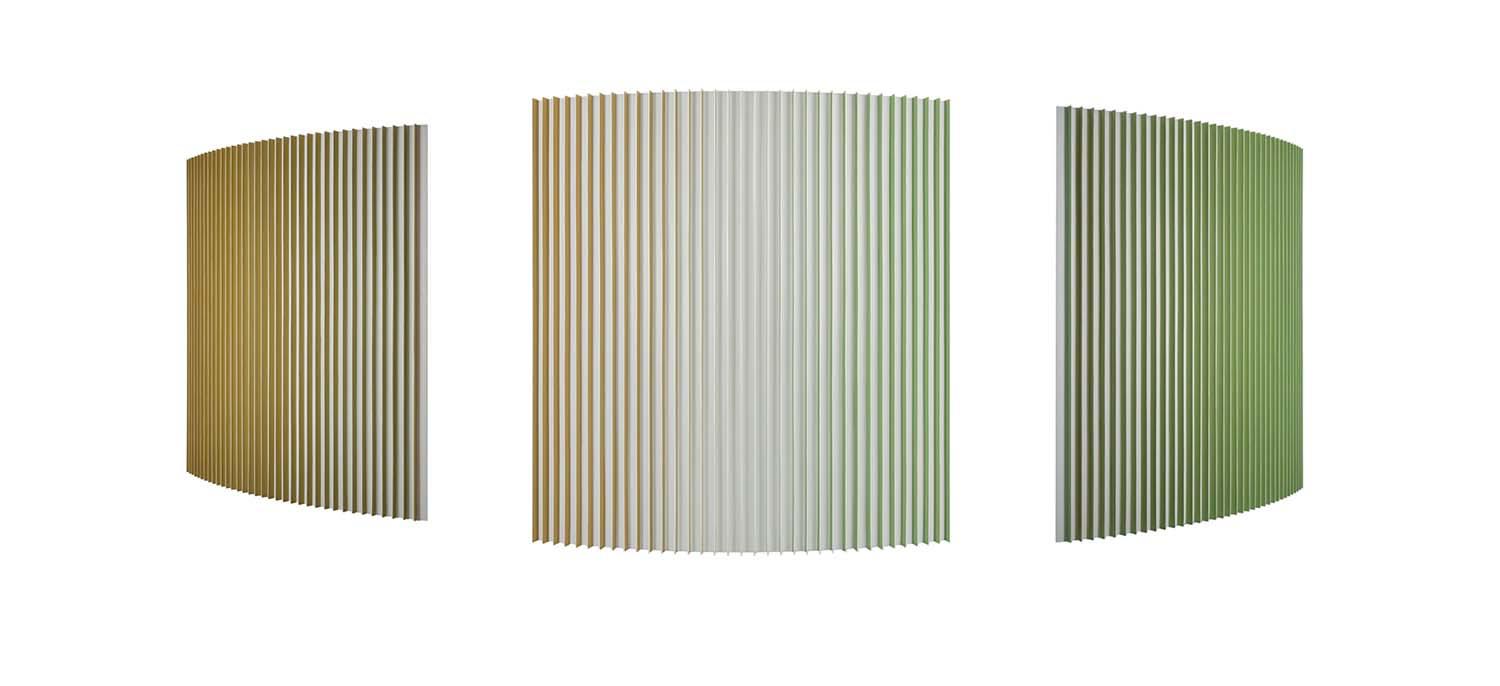
Enamel on aluminium, 80 x 80 cm
BRUSSELS - At the 71st edition of BRAFA Art Fair, one of Europe's oldest and most established art fairs, Rashid Al Khalifa presents Spectrum XXIV (2025) with Boon Gallery. The presentation, initiated by TRIYAD, marks Al Khalifa's first participation in BRAFA and represents a significant moment for the presentation of contemporary abstraction from the Gulf within a European art fair historically defined by dialogue across artistic periods.
Long recognised for its emphasis on continuity across artistic periods, BRAFA provides a rigorous context in which contemporary works are shown alongside Old Masters, modern art, and design. Within this framework, Spectrum XXIV enters a broader conversation around craftsmanship, structure, and formal coherence. Presented within a booth bringing together works by artists such as Joan Mir6, Richard Diebenkorn, Henry Moore, and Antony Gormley, Al Khalifa's work introduces a contemporary abstraction operating at the intersection of painting, sculpture, and architecture, grounded in repetition, surface, and light.
Spectrum XXIV belongs to Al Khalifa's ongoing Spectrum series, which engages with principles of repetition rooted in architectural traditions, where pattern extends conceptually beyond the frame to suggest balance and continuity. Repetition operates not as ornament but as a structural logic through which harmony is articulated, translated into a contemporary visual language informed by geometry and spatial perception.
Executed in enamel on aluminium, the work adopts a convex form that activates the surface through light, space, and movement. Colour and reflection shift as the viewer changes position, transforming the work into a dynamic perceptual experience. The palette and materiality draw on Bahrain's landscape and built environment, establishing a measured dialogue between regional architectural references and contemporary abstraction.
Presented at BRAFA, Spectrum XXIV underscores the fair's capacity to accommodate contemporary practices that are deeply rooted in tradition while remaining fully engaged with modern sensibilities. The clarity of form and restraint of means position Al Khalifa's practice in proximity to minimalist and post-minimalist languages.
Beyond his artistic practice, Rashid Al Khalifa plays an active role in the cultural life of the Gulf. He serves as Chairman of Bahrain's National Council for Arts and is the founder of the RAK Art Foundation, an institution dedicated to supporting artistic production, fostering cross-cultural exchange, and encouraging international collaboration.
About Rashid Al Khalifa
Born in 1952 in the Kingdom of Bahrain, Rashid Al Khalifa moved to the United Kingdom in 1972 to study at Hastings College of Arts and Technology in Sussex. Following his return to Bahrain in 1978, he began developing a painting practice rooted in close observation of landscape, light, and atmosphere, producing early works inspired by the desert, the sea, and the country's historical sites.
These atmospheric landscapes marked the beginning of his artistic career. During the 1980s, his practice evolved toward figurative compositions, in which elements of landscape and the human form were combined through increasingly fluid and gestural mark-making. In the 1990s, his work underwent a further shift as decorative elements, pattern, foliage, and a darker colour palette became more prominent, signalling a gradual move toward abstraction.
In the early 2000s, Al Khalifa introduced the convex canvas, a pivotal development that transformed his approach to surface, light, and spatial perception. This innovation allowed for a synthesis of colour, gesture, and form that would become central to his practice. By the late 2000s, he began experimenting with new materials, moving beyond canvas toward aluminium, whose smooth surface and reflective properties enabled a more architectural and minimal language to emerge.
From this point onward, Al Khalifa's work became increasingly informed by the structural logic of geometry, repetition, and the mechanics of architectural design. Drawing inspiration from Bahrain's rapidly evolving built environment, as well as from principles rooted in Islamic design, he began translating these influences into abstract compositions that engage light, surface, and movement as integral components of the work.
Works produced from 2015 onwards reflect a sustained engagement with this language. Characterised by clarity of form and precision of execution, they balance visual strength with a sense of restraint and contemplation. Across different media and periods, Al Khalifa's practice remains unified by a continuous process of development, reflecting both personal evolution and the changing cultural and physical landscape of Bahrain.
Alongside his artistic practice, Rashid Al Khalifa plays an important role in the cultural life of the Kingdom of Bahrain. He serves as Chairman of the National Council for Arts, Bahrain, and is widely recognised as a leading patron of the arts. In 2020, he founded the RAK Art Foundation in Riffa, Bahrain, an institution dedicated to supporting artistic production, encouraging cross-cultural exchange, and fostering international collaboration.