


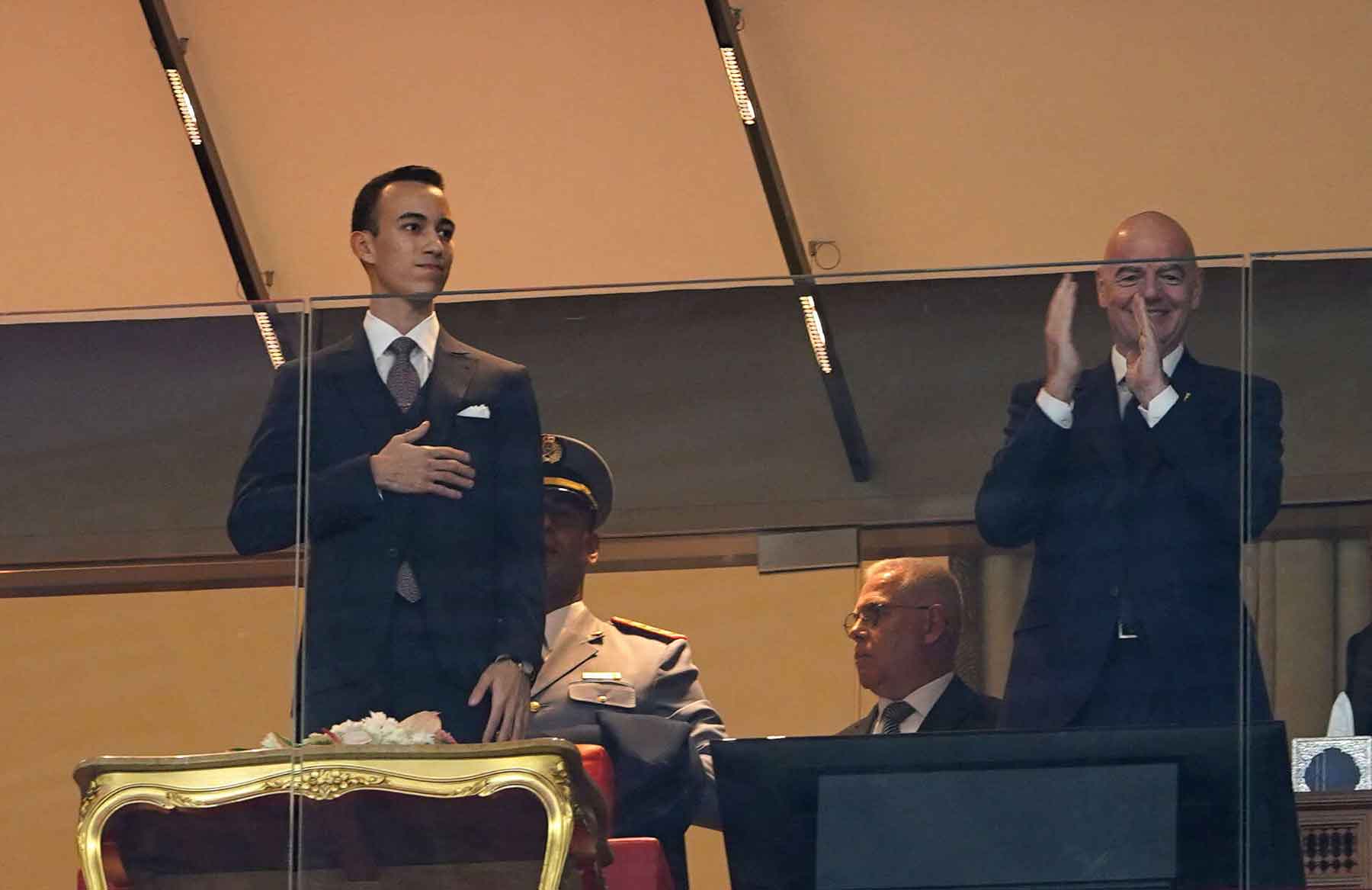
Morocco’s Crown Prince Moulay El Hassan and FIFA President Gianni Infantino in the stands at Prince Moulay Abdellah Stadium in Rabat, December 21, 2025.
Crown prince opens AFCON 2025 as Morocco stages dazzling launch
Football itself was woven into the spectacle, with the 24 qualified teams honoured in a symbolic tribute.
Monday 22/12/2025
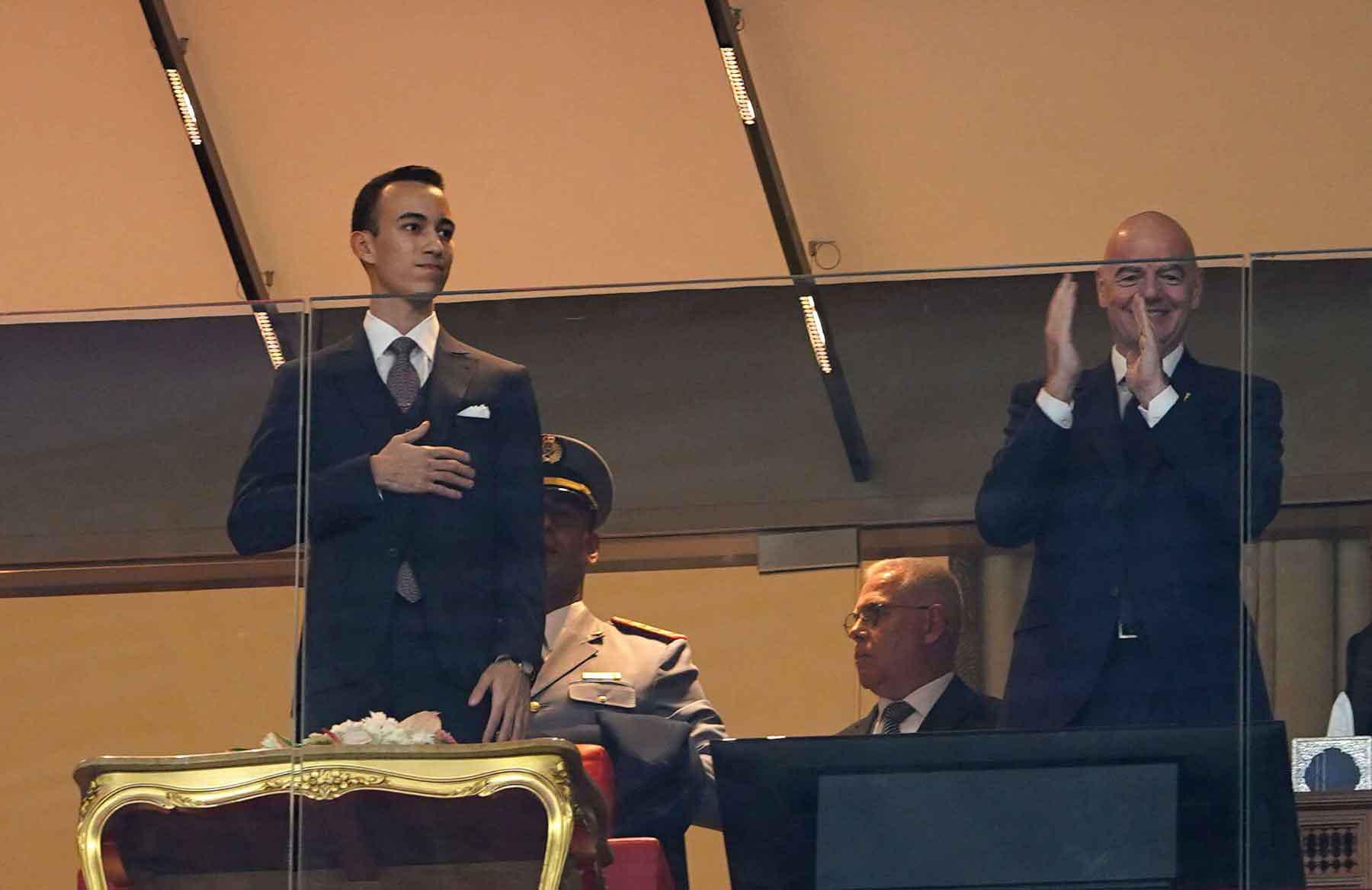
Morocco’s Crown Prince Moulay El Hassan and FIFA President Gianni Infantino in the stands at Prince Moulay Abdellah Stadium in Rabat, December 21, 2025.
RABAT –
Morocco launched the 2025 Africa Cup of Nations on Sunday with a lavish opening ceremony in Rabat, attended by Crown Prince Moulay El Hassan, a royal presence that underscored the strategic importance the kingdom attaches to Africa’s premier football tournament.
The crown prince presided over the ceremony at the Prince Moulay Abdellah Stadium, officially opening the 35th edition of the Africa Cup of Nations, which runs until January 18. His attendance, alongside senior Moroccan officials and foreign dignitaries, was widely seen as a strong signal of state-level backing for the tournament and Morocco’s broader sporting and diplomatic ambitions in Africa.
Organisers said the ceremony was designed to reflect Morocco’s African roots and cultural diversity while showcasing its organisational capacity and security readiness. Thousands of spectators packed the stadium hours before kick-off, transforming the capital into a scene of celebration and colour as fans from across the continent gathered for the opening match.
The show began with a black-and-white countdown before shifting into a sweeping visual narrative centred on the fictional character Siraj al-Diyaa, portrayed as a guardian of Moroccan traditions. Carrying a glowing lantern, the figure travelled symbolically through the six host cities, with beams of light forming illuminated hexagonal shapes that linked deserts, coastlines, mountains and plains, a metaphor for national unity and geographic diversity.
As the stadium lights rose, the stands and pitch were transformed into a moving tableau of colour and sound. Pulsing light effects swept across the field in time with drums and tightly synchronised choreography, presenting what organisers described as a portrait of a dynamic Morocco within a united Africa.
Music formed the backbone of the ceremony, carrying a clear message of cultural continuity and openness. Gnawa rhythms blended with Amazigh and Saharan melodies in a journey through Morocco’s regions and history, merging ancestral traditions with contemporary artistic expression. Each segment highlighted an aspect of Moroccan identity while celebrating the wider cultural richness of the African continent.
Football itself was woven into the spectacle, with the 24 qualified teams honoured in a symbolic tribute. Organisers stressed that the Africa Cup of Nations is “not merely a sporting competition, but a shared African story of passion, pride and collective memory.”
The choice of Rabat as host city carried added symbolism. As the kingdom’s political and cultural capital, the city provided a setting befitting the scale of the event. The Prince Moulay Abdellah Stadium, unveiled in its renovated form, stood out for its modern facilities and design, reinforcing Morocco’s credentials as a host of major international sporting events.
The opening match between Morocco and Comoros capped an evening that many observers described as a landmark moment for African football. For many in attendance, the ceremony confirmed that AFCON 2025 had already secured a place in the continent’s collective memory.
International reaction was swift. US Ambassador to Morocco Richard Duke Buchan praised the opening as “wonderful and impressive” in a post on the US embassy’s Facebook page, saying it sent “a strong message to the African continent” about Morocco’s professionalism and cultural confidence in hosting major events.
He added that the United States was keen to learn from Morocco’s experience as it prepares to co-host the 2026 World Cup with Canada and Mexico, highlighting opportunities for cooperation in training, event management and large-scale logistics.
Security preparations were a central pillar of the tournament. Director-General of National Security and Territorial Surveillance Abdellatif Hammouchi conducted field visits to oversee arrangements linked to the opening ceremony and the wider competition. Authorities deployed a comprehensive security system covering stadiums, crowd movement and surrounding areas, supported by command-and-control centres equipped with advanced technology.
Border controls were also reinforced to manage the influx of foreign supporters, while dedicated security teams were assigned to accompany fans inside and outside stadiums to ensure smooth movement and safety.
An African police cooperation centre has been established for the duration of the tournament, bringing together representatives from the security services of participating countries, alongside officials from FIFA, the Confederation of African Football and Interpol. The aim is to facilitate real-time information-sharing and coordination throughout the competition.
Officials say Morocco’s long experience hosting major sporting events, including previous AFCON finals, the FIFA Club World Cup and other international tournaments, has helped cement international confidence in its organisational and security capabilities.
Beyond the pitch, AFCON 2025 is seen as a boost to tourism, infrastructure and Morocco’s sports diplomacy. Analysts say the royal presence at the opening ceremony reinforced the message that the tournament is part of a broader national vision linking culture, security and international cooperation.