The window to Assilah


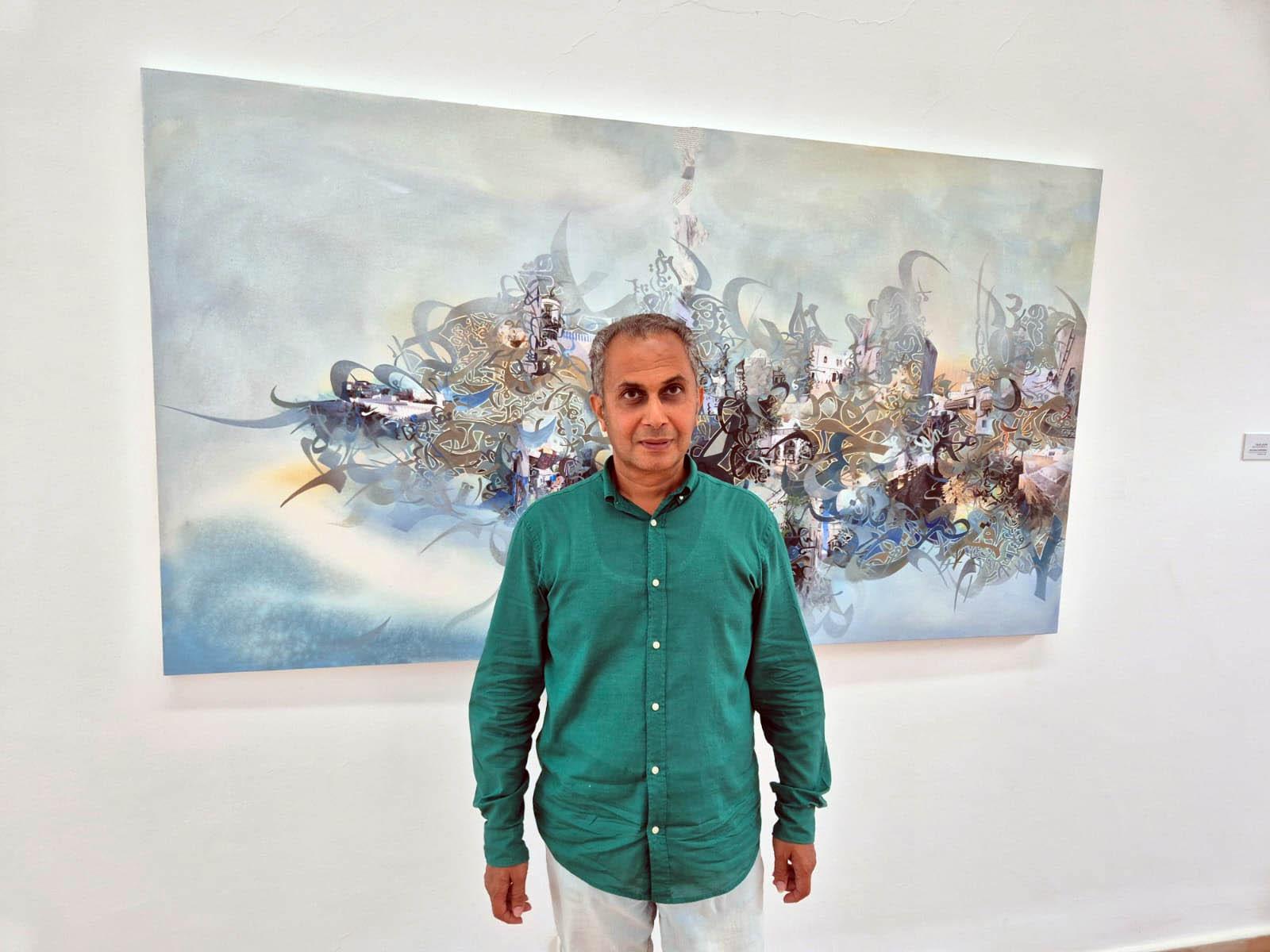
ASSILAH - Syrian Artist Khaled Al-Saai dedicated his exhibition at the Hassan II International Center to the city of Assilah as a token of gratitude to late Mohamed Benaissa, the founder of the Assilah Cultural Moussem.
“My artworks are a dedication and gratitude to Mohamed Benaissa, a great man,” Saai told Middle East Online.
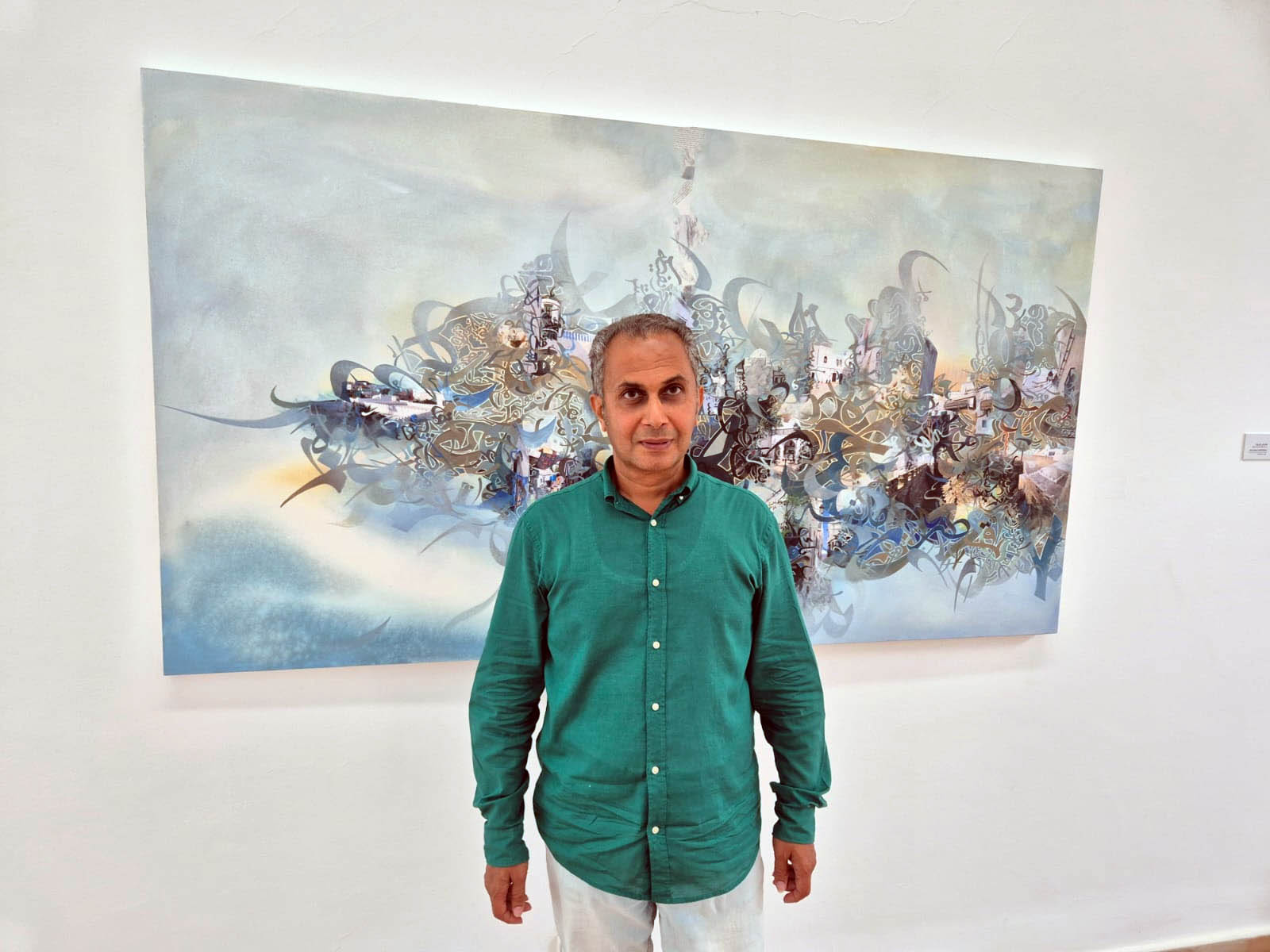
Several artworks are about literary and poetic reflections in Assilah. In every piece, there are possible texts by several poets, including Syrian poet and writer Nouri Al-Jarrah.
“They depict my personal relation with Assilah and lovely memories in the beautiful coastal city which is rich in history and culture…dealing with Assilah in its social aspect rather than its geography,” said Saai.
The talented Syrian artist said that his artworks are a depiction of the meaning that Assilah is the city of history, culture, and for him personally the city of love and emotion.
To understand his paintings, Saai leaves the explanation up to our imagination, background and personal feeling. “This is why I want to leave it open to interpretation for everybody. People could just absorb it according to anything they have in mind.”
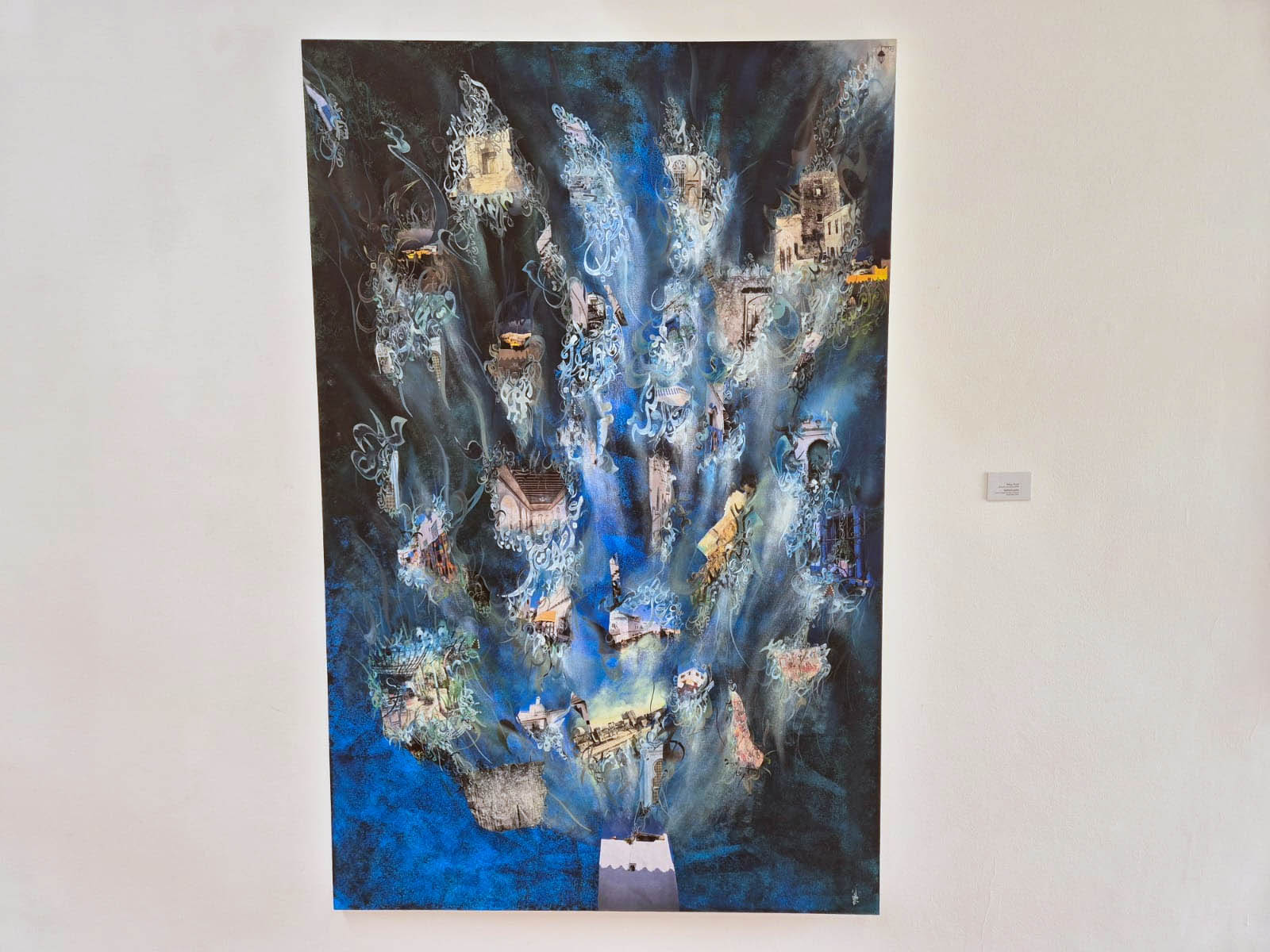
The Arabic letter is the conductor of the visual orchestra for him, but it is supported by many things: from the collage pieces, the fabric pieces, from many elements that contribute to refurnishing and rebuilding Assilah according to his perspective.
Inspired by "Qriqiya" area in the old medina of Assilah, he rebuilt the city in a mythical and fantastical way like the cities of Ali Baba and Sinbad.
“On my first visit to Assilah, I felt that it couldn't be real. It could be a metaphor, but in reality, it is indeed real. So I loved that. I transferred this to a specific vision; I demolished the city and rebuilt it, according to me and the way I see it,” stressed Saai.
In one of his paintings, a small window is from which Assilah and its history depart, taking us to several historical sites, including Bab al Houmar, Raissouli Palace and the immaculate church.
“I wanted in this painting is that everything begins with the window. The reason is that I considered Assilah to be the balcony of imagination. Meaning, the sons of the city, each one is present in his city, present in his house, but at the same time he is present in Spain, present in Italy. He has ambitions, he travels. The city is stable, but the imagination has traveled, it has taken the houses with it,” said Saai.
What is more important is the harmony between the image and the letter — the letter that conveys the language — and the image that solidifies it.
Saai blends photos and drawings together in some of his paintings and says that every painting differs from one another and depicts a love story and his relationship with Assilah.
Saai has been coming to Assilah for 20 years and has created nearly 19 mural works on the medina walls, including a fresco about the devastating earthquake that struck the Al Haouz region in September 2023.
“People still reminds me of the painting because the work is huge…I documented all the cities affected and damaged by the earthquake and wrote the words, most of them in Moroccan Darija and grouped "the oriental scripts" — Thuluth and Naskh scripts — with the Maghrebi scripts, a kind of visual cross-pollination.
He wanted to focus on the cohesion, empathy, and solidarity among Moroccans. How they came together and how they contained this crisis.
“what doesn't kill you strengthens you,” said Saai.
“I am Syrian. I haven't done an exhibition about the city of Al-Mayadeen nor about Damascus, but I have done an exhibition about Assilah. The entire exhibition is about the city. Yes, so this thing is exceptional and unique.
He recalled that there was an exhibition in London in 2020 called "Impressions on Cities."
“Every artist would choose 5 five cities. So I chose Damascus, the city of Al-Mayadeen, and Assilah. I had choices for 3 pivotal cities in my life, ancient cities, especially since Assilah doesn't have the history of Damascus or Al-Mayadeen, ut for me personally, it possesses something else; another dimension. Meaning, the 3the cities achieved a kind of complementarity for me, and this is important,” he said.
“I mean, I, as an artist, see that my language, which is the Arabic letter, is a very important message, and it is an identity. When the viewers look at these works, the see in it a specificity,” he explained.
Saai said that the plastic/visual language of the Arabic letter was now on the rise.
“Now, for example, in Morocco, there is a large number of important classical Maghrebi calligraphers on the global map and the level of calligraphy in the Arab world is now very high,” he said.
Saai said English dominates everything in general, but the language of the letter as an established art exists, and the proof is museums in America, in Germany and many other places in the world acquire his works because they see in them a different language and contemporariness. For me, it is very important that I present something contemporary and different.
“This also proves that the Arabi letter is a real bet; it has a say and will not end,” he said.
For him Arabis is language, a voice, history while the Arabic letter is also the conversion of the sound of language into form, meaning converting music into a visual point.