

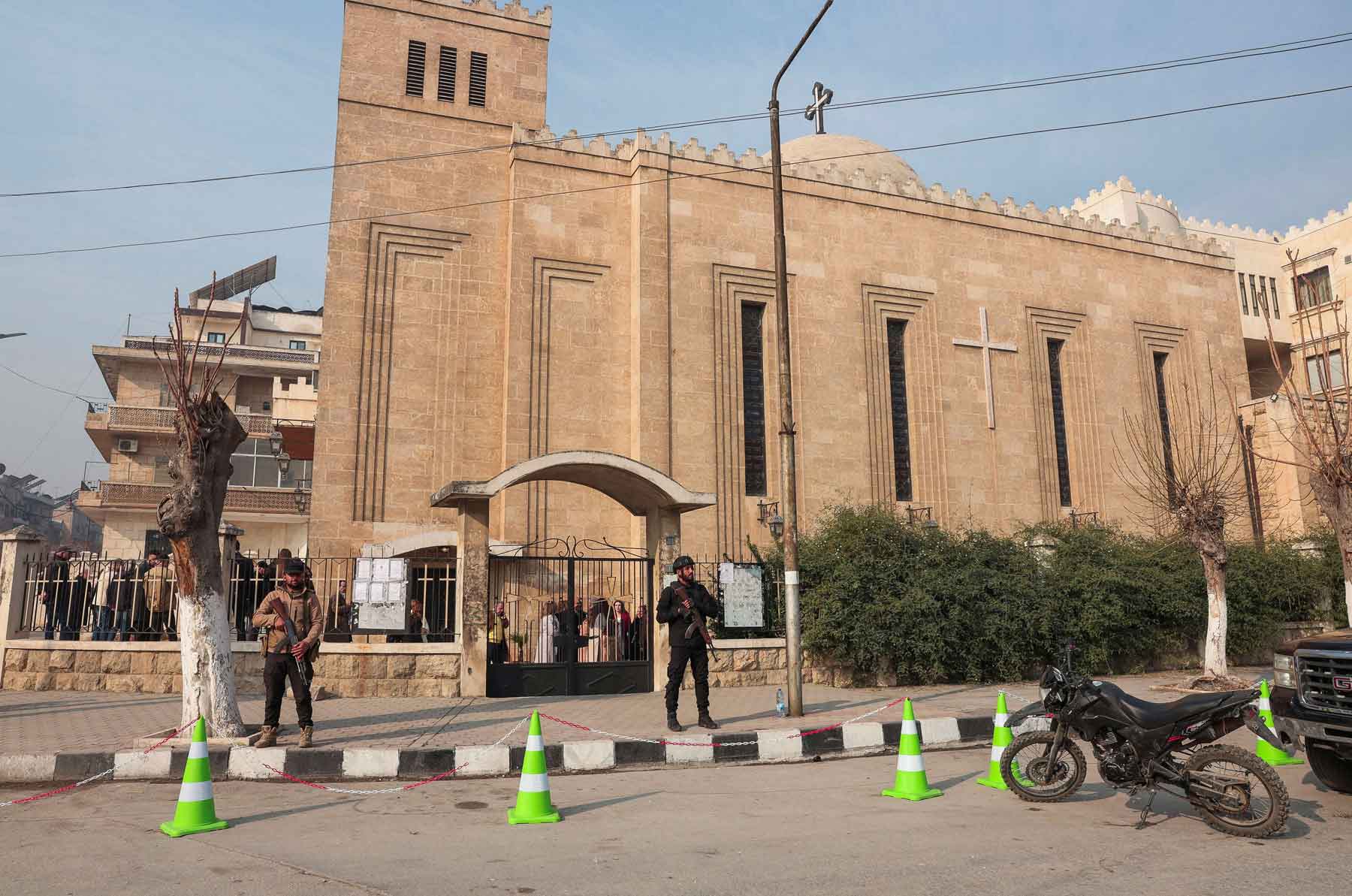
Members of the security forces stand in front of the St. Joseph Chaldean Cathedral on the day Christians attend Christmas Mass celebrations at the Chaldean Catholic Church, in Aleppo, Syria, December 25, 2025.
ISIS Warns of ISIS resurgence after foiled New Year attacks
Intelligence indicated ISIS has been preparing “suicide operations and attacks targeting New Year celebrations in a number of governorates.”
Friday 02/01/2026

Members of the security forces stand in front of the St. Joseph Chaldean Cathedral on the day Christians attend Christmas Mass celebrations at the Chaldean Catholic Church, in Aleppo, Syria, December 25, 2025.
DAMASCUS –
Syrian authorities said on Thursday they had foiled Islamic State (ISIS) plans to carry out suicide attacks on churches and public gatherings during New Year celebrations, after a suspected jihadist detonated explosives during a confrontation with security forces in Aleppo.
The interior ministry said the incident occurred on New Year’s Eve in the Bab al-Faraj district of Aleppo, where a police officer became suspicious of a man later identified as an ISIS operative. During questioning, the suspect opened fire, killing one member of the security forces, before blowing himself up as officers attempted to arrest him. Two other officers were wounded in the explosion.
In a statement, the ministry said intelligence indicated ISIS had been preparing “suicide operations and attacks targeting New Year celebrations in a number of governorates, particularly Aleppo,” with churches and civilian gathering places listed among the intended targets. Security measures were tightened nationwide in response to the threat, it added.
Resurgent ISIS activity
The incident comes amid a resurgence of ISIS attacks in areas controlled by Damascus, raising concerns about the group’s ability to exploit Syria’s fragile security environment more than a year after the fall of longtime ruler Bashar al-Assad in December 2024.
Last month, ISIS was blamed for an attack in the ancient city of Palmyra that killed two US soldiers and an American civilian. Washington responded by launching air strikes on dozens of ISIS positions across Syria. The Syrian Observatory for Human Rights said at least five ISIS members were killed in the strikes.
Syrian authorities have since stepped up counter-terrorism operations, announcing on December 25 that a senior ISIS leader had been killed during a security raid.
In November, Syria formally joined the US-led coalition fighting ISIS, following a visit by President Ahmed al-Sharaa to Washington. Sharaa, an Islamist leader and former jihadist, previously fought ISIS during the height of Syria’s civil war, even as his past has drawn scrutiny from Western and regional observers.
The cooperation marks a significant shift in Syria’s international posture after years of isolation, though the security situation on the ground remains volatile.
Minority fears and sectarian violence
Despite renewed efforts to combat ISIS, concerns persist among Syria’s minority communities, who have borne the brunt of sectarian violence since Assad’s removal. Civilians from the Alawite community, to which Assad belonged, were killed in mass attacks along the coast in March, while clashes erupted in the Druze-majority province of Sweida in July.
In June, a suicide bombing inside a church in Damascus killed 25 people. Syrian officials blamed ISIS for the attack, although a little-known Sunni extremist group, Saraya Ansar al-Sunna, claimed responsibility. Analysts have suggested the group operates as a front for ISIS, allowing the organisation to obscure its direct involvement.
Security experts warn that IS remains capable of staging high-profile attacks despite suffering territorial defeats, particularly by exploiting sectarian tensions and symbolic targets such as religious institutions.
Thursday’s incident, officials said, underscores the continuing threat posed by jihadist networks and the challenges facing Syria’s new authorities as they seek to stabilise the country and reassure minorities ahead of sensitive religious and national events.