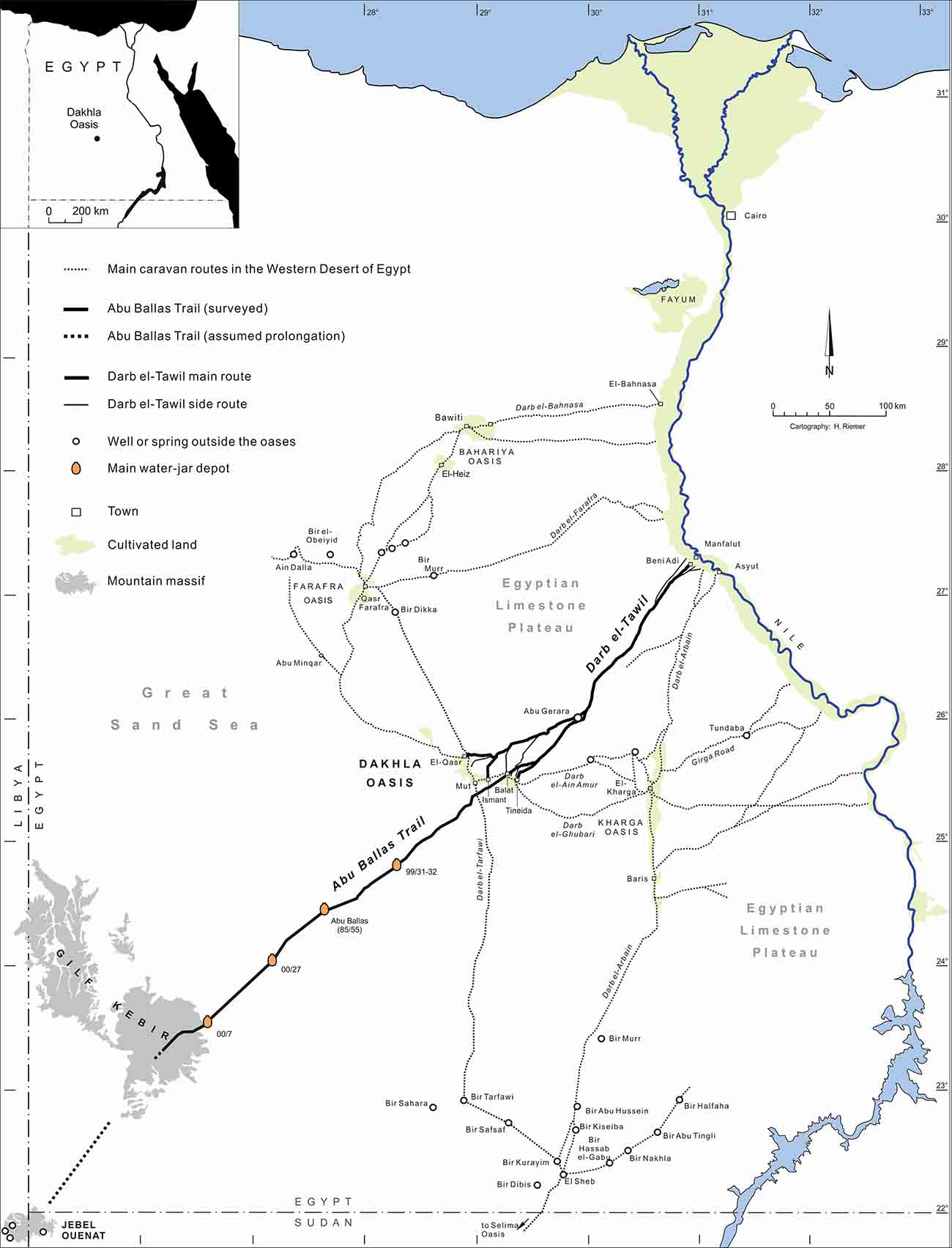
“Map showing the main caravan routes in Egypt’s Western Desert, including the Abu Ballas Trail. Cartography: Heiko Riemer”


Somewhere in Egypt’s Western Desert, long before paved roads or satellite navigation, caravans moved slowly through hundreds of kilometers of rock and sand carrying water, food and various commodities on the backs of donkeys. The Sahara is usually imagined through the camel. Yet for centuries, another animal made movement across these landscapes possible.
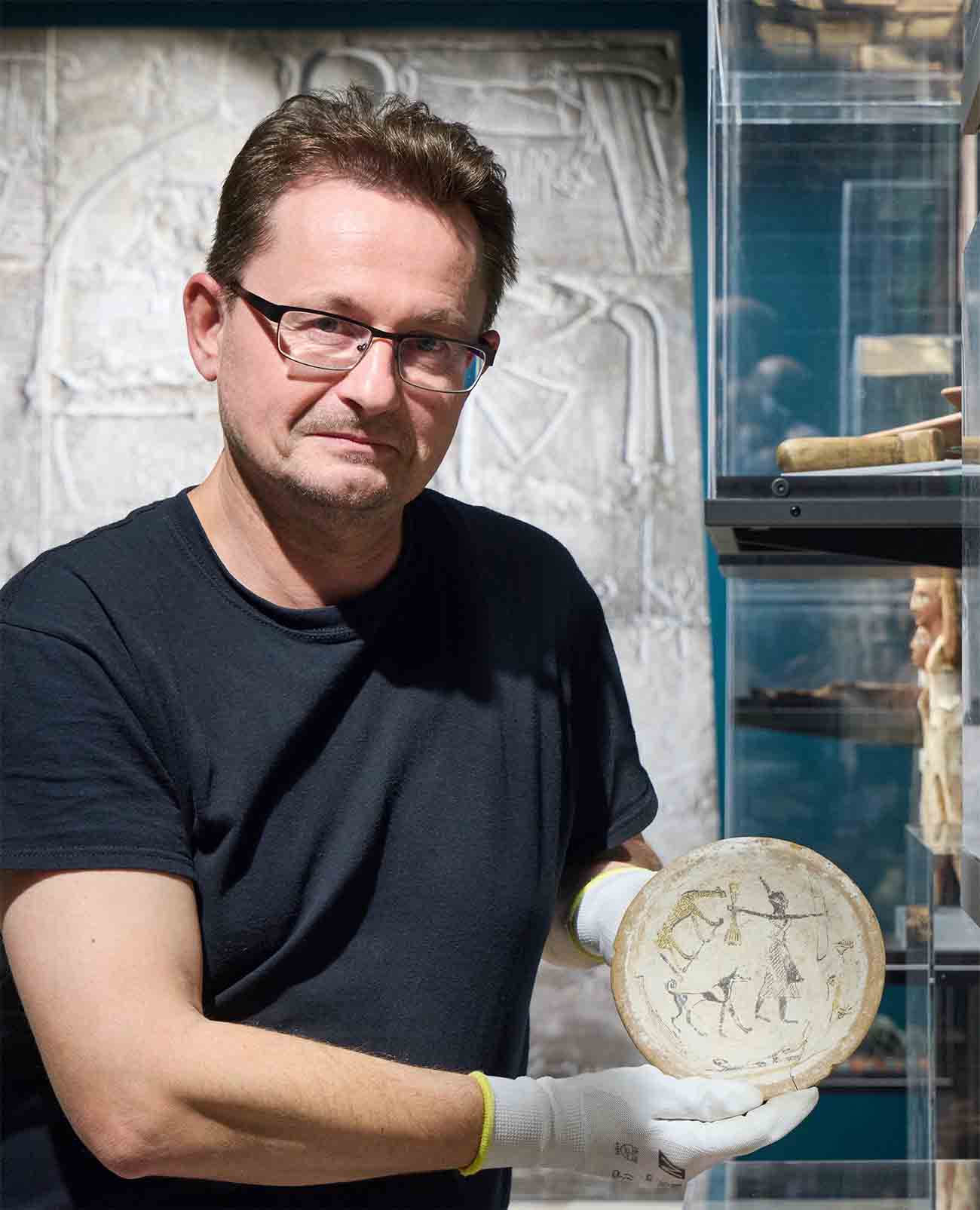
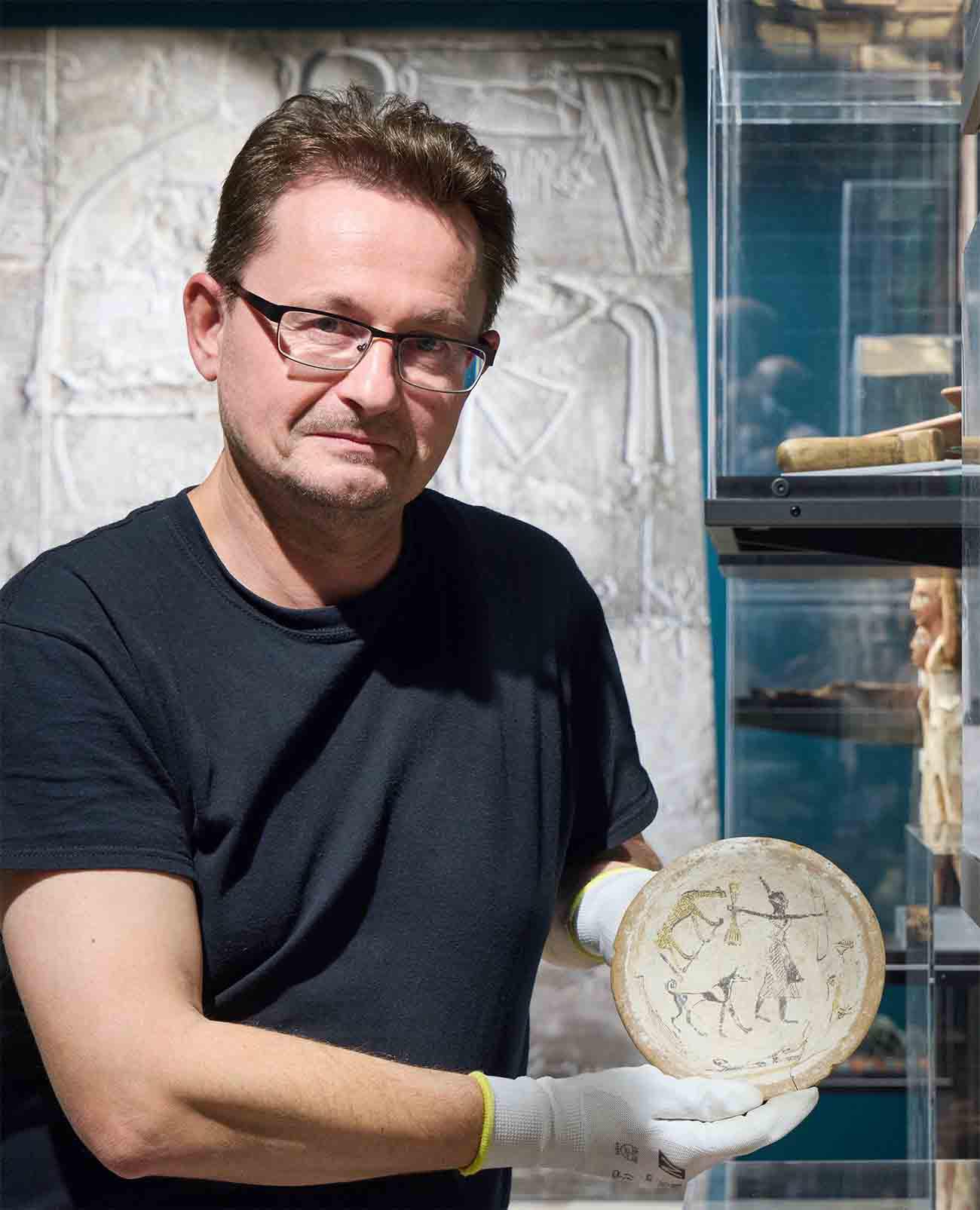
For German Egyptologist Dr. Frank Förster, the traces left behind by those journeys became the focus of years of work in some of the most remote parts of Egypt. Now curator at the Egyptian Museum of Bonn University, Förster has spent much of his career studying ancient caravan routes that once connected the Nile Valley to distant regions deep inside the Western Desert. His research based at the University of Cologne has helped challenge older assumptions about how people moved across the Sahara before camels became widespread.
His path into archaeology began with something small enough to fit in the palm of his hand.
During a school trip to the Roman settlement of Xanten in western Germany, Förster picked up a Roman coin lying on the ground. The coin itself was unremarkable, worn smooth with age, but the sensation stayed with him. Suddenly, the ancient world no longer felt sealed behind museum glass or buried beneath dates in textbooks. “It was the intense feeling of being connected to people who had once held it in their hands some two millennia ago,” he recalls.
Hieroglyphs soon captured his attention. After finishing school, he traveled to Egypt for the first time and returned convinced that he wanted to study Egyptology. At the University of Cologne, he studied Egyptology, Classical Archaeology and Prehistoric Archaeology before gradually moving toward research that, at the time, occupied only a small corner of the discipline.
Two decades ago, much of Egypt’s Western Desert remained archaeologically understudied. Attention centered on the Nile Valley and its monumental architecture, tombs, etc., while the desert itself was often treated as marginal despite covering most of Egypt’s territory. Many researchers doubted that regular long-distance travel across such arid landscapes had been possible before the widespread use of camels.
That perception began to shift after traces of an ancient caravan route south-west of Egypt’s oasis chain were identified by explorers and archaeologists. The route later became known as the Abu Ballas Trail. Through collaboration with German archaeologist Dr. Rudolph Kuper and his team, Förster became involved in the project and later based his doctoral work on the trail and its implications for understanding early desert mobility.
The discoveries pointed to something larger than scattered expeditions moving cautiously between oases. They revealed systems: planned movement, supply networks and repeated travel across terrain that still appears forbidding today.
Before camels arrived in North-East Africa during the middle of the first millennium BC, donkeys were the most practical transport animals available for these journeys. They required relatively little food and water and could endure harsh desert conditions for long periods once trained for caravan travel.
Förster believes their importance has often been overlooked.
“In agriculture, daily labor and caravan transport, they were essential,” he says, recalling a phrase frequently used by Rudolph Kuper: “The donkey was the animal on whose back the Egyptian state grew to greatness.”
The logistics behind these journeys depended on careful preparation. Water depots were established across the desert using large storage jars placed at intervals that corresponded to the needs of the pack animals. This way, donkey caravans had already opened routes used for trade, communication and the extraction of resources from remote regions long before the camel transformed transport across the Sahara.
Yet the donkey held an ambivalent position in ancient Egyptian culture. It appeared mostly as a working animal associated with labor and burden. In some religious contexts, it also carried negative symbolic meanings connected to the god Seth. Scenes of donkey caravans are surprisingly rare in Egyptian art. Although this animal was of crucial importance to the economy and daily life in ancient Egypt, it was rarely depicted in a prestigious manner.
Tracing those desert routes today requires a combination of archaeological fieldwork, satellite technology and patient observation on the ground. Camel caravan routes can sometimes still be identified through broad track systems even visible from space. Donkey routes are harder to detect. Because the animals often moved across rocky surfaces, they left behind only faint traces.
Researchers instead look for quieter signs scattered through the landscape: carefully arranged stones marking direction, pottery sherds dotting the routes or abandoned storage jars worn smooth by centuries of sand and wind.
The work itself can become physically exhausting in ways photographs rarely capture. Every expedition requires detailed planning involving water supplies, fuel, navigation systems and emergency contingencies in regions where distances are measured in hundreds of kilometers and mechanical failure can quickly become dangerous.
Still, the desert exerts a strange attraction on those who spend enough time there.
Förster speaks of nights behind sand dunes under skies crowded with stars and of landscapes that never remain entirely still. Wind reshapes the terrain constantly. Archaeological remains disappear beneath moving dunes and then reappear years later without warning. A place that seems empty at first glance may contain traces of human activity stretching back thousands of years.
Some of the most demanding fieldwork of his career took place in the Wadi Sura region near Egypt’s border with Libya, home to the famous “Cave of Beasts,” one of the largest concentrations of prehistoric rock art in the eastern Sahara. Beginning in 2009, Förster joined a German project documenting thousands of prehistoric images using high-resolution photography and 3D laser scanning.
The many weeks of isolation shaped daily life as much as the archaeology itself. Temperatures climbed sharply during the day, nights turned unexpectedly cold, and sandstorms remained a constant possibility.
Then there were the moments no field manual prepares researchers for.
During one expedition, the team encountered refugees and smugglers stranded nearby after one of their vehicles broke down in the desert. On other occasions, they came across freshly dug graves far from any settlement. Such encounters altered the atmosphere of the work. The desert and its dangers no longer felt remote in the abstract. Ancient caravan routes existed within landscapes still crossed by people moving under difficult circumstances today.
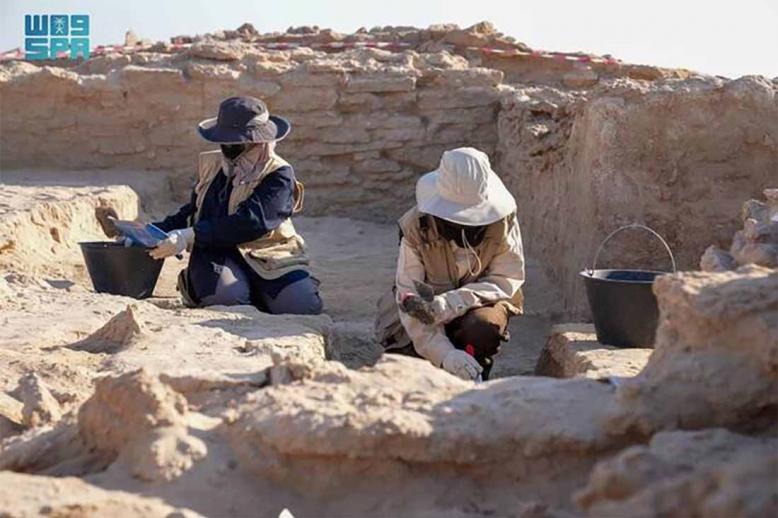
The desert continues to produce discoveries in quieter ways as well. Förster recalls excavations at Khufu Hill southwest of Dakhla Oasis, where evidence linked to the reign of Pharaoh Khufu emerged near ancient extraction sites for mineral pigments. Among others, he and his colleagues uncovered fragments of clay sealings bearing hieroglyphic impressions once used to secure containers.
The fragments revealed organized administrative activity operating deep inside the desert around 4,500 years ago. Places that appear isolated today were once connected to wider systems of transport, labor and state organization.
Many of those fragile sites now face growing threats. Modern graffiti, litter and expanding infrastructure projects increasingly damage locations that survived for millennia in relative isolation. When Förster recently returned to Khufu Hill after many years, he found ancient rock surfaces marked by modern inscriptions carved directly beside Pharaonic images.
He believes preservation depends not only on official protection measures, but also on public awareness and continued cooperation between Egyptian and German researchers working to document endangered sites before more disappears.
“The desert makes up more than ninety percent of modern Egypt, yet it is often overlooked,” he says.
Beneath the silence of the Western Desert remain the traces of movement: abandoned water stations, forgotten caravan routes and the hoofprints of animals that crossed waterless territory long before the camel became the symbol of the Sahara.