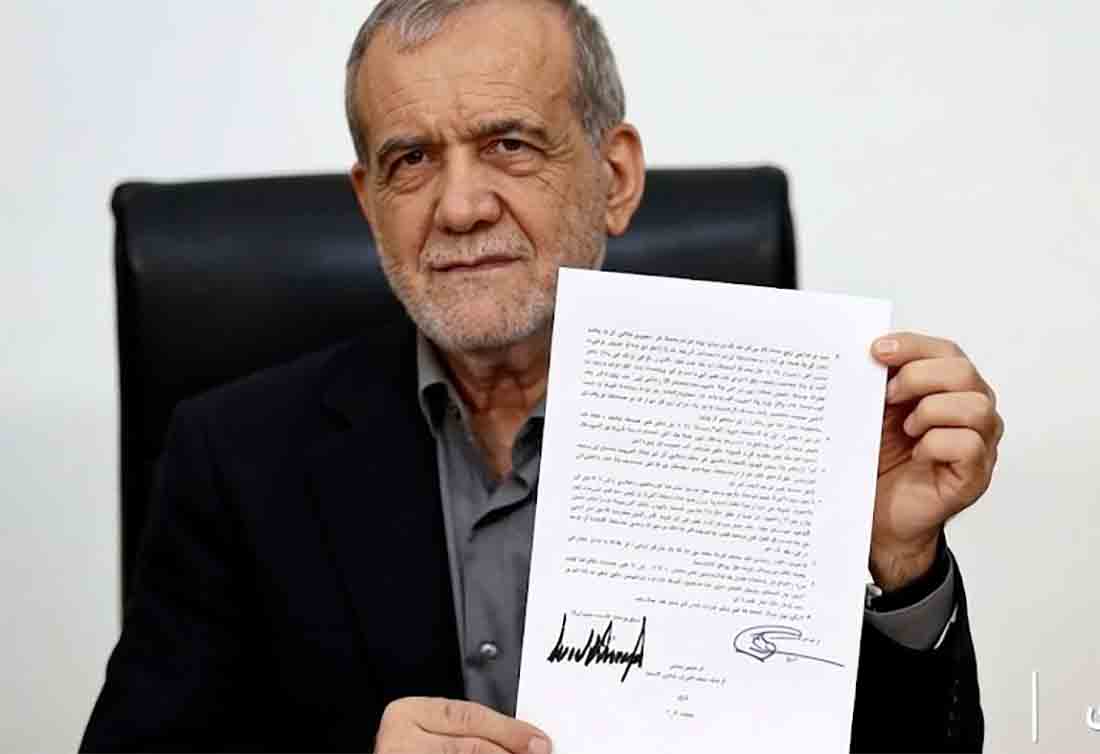
Iran’s President Masoud Pezeshkian
Cracks at the top: Iran’s leadership struggles to maintain control
President Masoud Pezeshkian's recent announcement that 20 million barrels of oil would be allocated to the Islamic Revolutionary Guard Corps (IRGC) has also attracted attention. Critics argue that such measures reflect efforts to maintain political cohesion among powerful institutions at a time when the government faces growing internal and external pressures.
Wednesday 24/06/2026
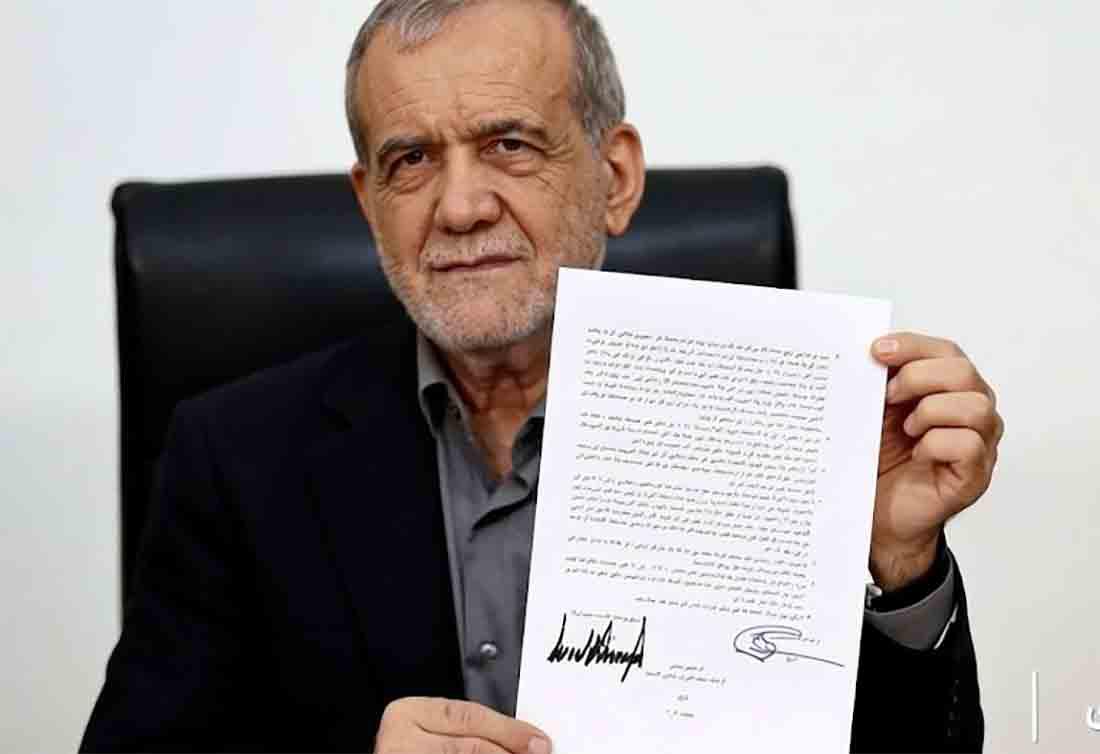
Iran’s President Masoud Pezeshkian
Political systems that project strength usually speak with one voice when it comes to major strategic decisions. When competing narratives emerge from within the state itself, they often reveal deeper divisions over the country's future. The debate surrounding the latest negotiations between Tehran and Washington appears to be one such case.
An article published by Tose'e Irani (Iranian Development) on June 22, 2026, titled “An Agreement on the Table; Defeat Narratives on the Airwaves and in the Media,” highlighted the growing dispute within Iran over the ongoing diplomatic process. According to the newspaper:
“At the very time the Iranian delegation was in Switzerland discussing the implementation of the first phase of the June 18 understanding, part of the domestic media space was presenting a completely different picture of what was actually taking place.”
(Tose'e Irani, June 22, 2026)
The statement points to the existence of competing narratives inside the political establishment. While government officials described the talks as continuing, some media outlets portrayed the negotiations as stalled or unsuccessful.
One example involved reports that the Strait of Hormuz had been closed during the negotiations. The newspaper noted that Foreign Ministry spokesman Esmaeil Baghaei later denied those reports, stating:
“Based on the memorandum ending the conflict, Iran’s armed forces have taken the necessary measures to ensure the safe passage of commercial vessels.”
(Tose'e Irani, June 22, 2026)
The significance of the incident was not only the accuracy of the report but also the timing. Conflicting messages emerged at a critical stage of the diplomatic process, raising questions about divisions among different political currents inside the regime.
Tose'e Irani described the situation in the following terms:
“The main battle began not in Switzerland but in the media sphere—a battle to shape public opinion and establish the preferred narrative of each political faction.”
(Tose'e Irani, June 22, 2026)
The newspaper also discussed criticism from the hardline outlet Raja-News, which challenged the government's interpretation of the negotiations. According to Tose'e Irani, the editor of Raja-News wrote:
“Hezbollah, like the Strait of Hormuz, will become a bargaining chip.”
(Tose'e Irani, June 22, 2026)
The comment reflected concerns among opponents of the talks that negotiations could eventually extend beyond economic issues and affect Iran's regional policies and alliances.
The article further noted that this type of disagreement is not new in the history of the Islamic Republic. Referring to the end of the Iran-Iraq War, it stated:
“In the final years of the Iran-Iraq War, acceptance of UN Security Council Resolution 598 faced serious opposition.”
(Tose'e Irani, June 22, 2026)
The comparison is significant because many hardliners continue to view major compromises with suspicion, particularly when they involve relations with the United States.
Recent political developments suggest that the debate is occurring against the backdrop of broader challenges. Economic pressures, inflation, declining purchasing power, and social discontent continue to affect large segments of Iranian society. At the same time, visible disagreements among political factions have become increasingly difficult to conceal.
President Masoud Pezeshkian's recent announcement that 20 million barrels of oil would be allocated to the Islamic Revolutionary Guard Corps (IRGC) has also attracted attention. Critics argue that such measures reflect efforts to maintain political cohesion among powerful institutions at a time when the government faces growing internal and external pressures.
In her speech at the Free Iran 2026 Conference in Paris on June 21, 2026, Maryam Rajavi argued that the Iranian regime has reached a political deadlock. Reaffirming the slogan “no to war, no to appeasement, and no to endless negotiations up until today. Instead, yes to uprising, yes to the freedom of the Iranian people through supporting their independent resistance to overthrow this ruthless regime.”. She added: “For years, when the Iranian Resistance warned that a viper does not give birth to a dove—when we said that no one should look for moderation, reform, or a change of behavior inside the dark tunnel of Velayat-e Faqih, and that appeasement was a dangerous illusion—many governments refused to accept it.”
The public dispute over negotiations, the conflicting messages coming from different centers of power, and the continuing economic difficulties facing ordinary Iranians all point to a system under considerable strain. While officials seek to project stability, the debates highlighted even by state-linked media suggest that important disagreements remain unresolved.
What makes the current situation noteworthy is that these divisions are becoming increasingly visible. The controversy surrounding the negotiations is not simply about foreign policy; it also reflects broader questions about the regime's future direction and its ability to manage mounting political and economic challenges.
Taken together, these developments suggest that the Islamic Republic is facing one of the most difficult periods in its recent history. Internal divisions, strategic setbacks, and worsening economic conditions have combined to create a far more fragile environment than in previous years. For Western governments, this reality raises important questions about the effectiveness of continued engagement and accommodation toward a regime that appears increasingly preoccupied with managing its own internal crises.
Hassan Mahmoudi is an Iran & Middle East political and Economic researcher.